
English Therapy: 5 Common Myths Explained
Discover the truth behind five common myths about English therapy, from language fluency and online sessions to crisis support. Learn what to expect and how to decide whether English-language counselling is right for you.

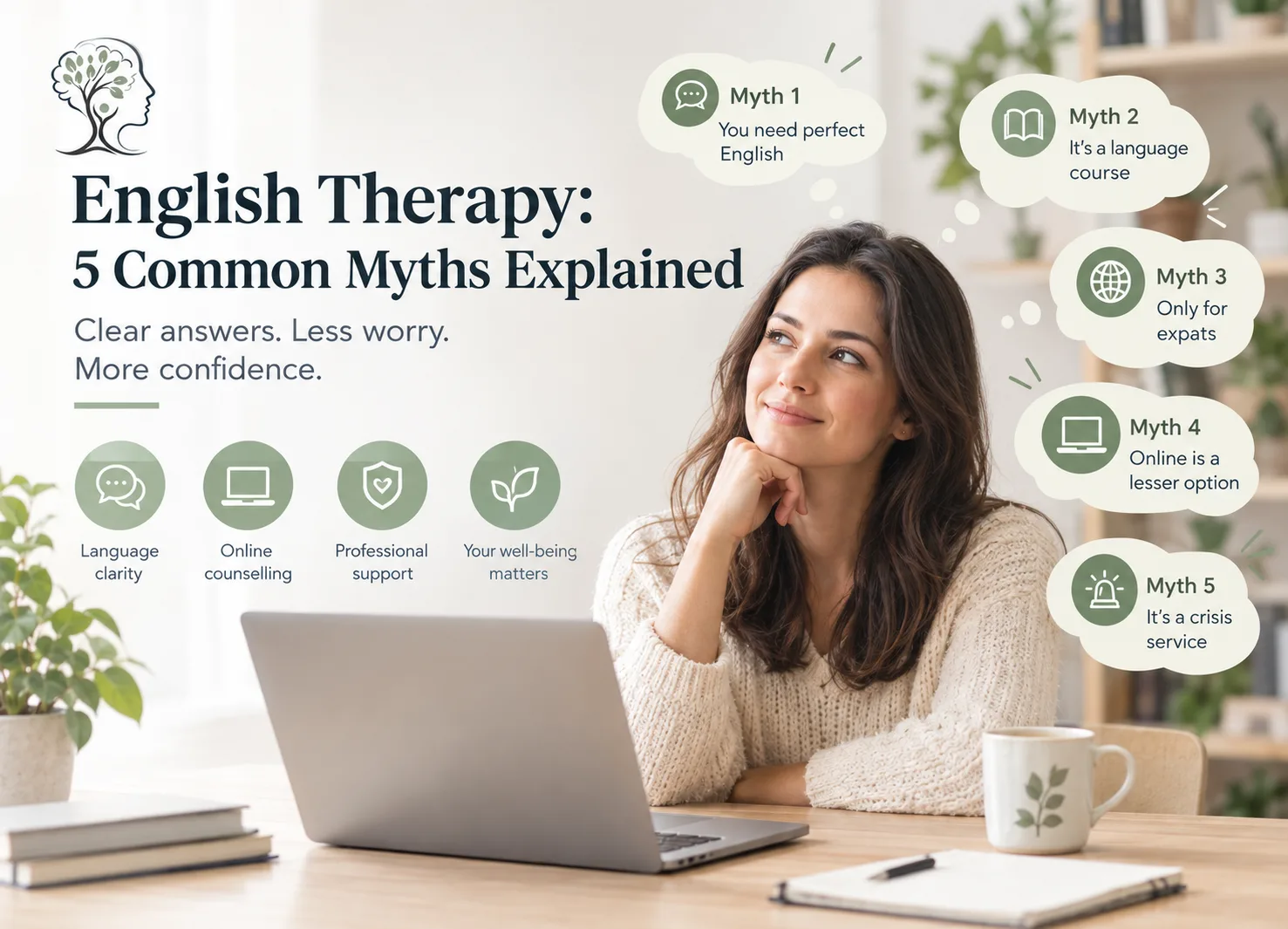
Before starting English therapy, many people worry about the same few things. They wonder whether their English is good enough, whether a session will feel like a language lesson, whether they will be understood, and whether online counselling can work at all. Some of these worries are reasonable. Others are myths that keep people from getting support they could use. This article takes five of the most common ones and sets out what is actually true, so you can start from accurate information. Once you have a sense of what you are looking for, the Inner Sense homepage is a good place to read about the service in full.
Myth One: You Need Perfect English to Start
Many people assume therapy requires polished vocabulary and flawless grammar. In practice, counselling is about what you mean rather than how elegantly you phrase it. A counsellor can ask clarifying questions and give you time to find the right words.
Some people feel comfortable starting with basic English, while others need more language confidence to discuss personal issues. Both experiences are common. If English feels too thin for the feelings you want to explore, you can tell your counsellor directly that you would like a little more time to think, and a good counsellor will usually respect that.
Myth Two: English Therapy Is a Language Course
Some people expect a session to involve grammar drills or vocabulary practice. That is usually not the aim. The conversation is about your life, your relationships, your work and your stress. English is simply the medium through which you talk about them. The focus is on your concerns, not on correcting your English. If you do want to build your English, a language course will serve that goal better, and the two can happily run side by side.
Myth Three: English-Language Counselling Is Only for Expats
Expats do use English-language counselling, and many of the concerns they bring are very real. Our expat-focused page on online therapy for expats describes some of those situations in more detail. The service, however, is not limited to people who have moved abroad. English-language counselling may suit people who feel more comfortable discussing personal concerns in English, including people who work in English-speaking teams or grew up with English at home.
What matters is the language you think in when a problem feels heavy, not the passport you hold or the city you live in.
Myth Four: Online Sessions Are a Lesser Version of Counselling
Online counselling is not automatically inferior to meeting in person. Video sessions suit many people, though not everyone, and suitability depends on your needs and circumstances. What matters most is whether you can speak openly and feel heard. That depends on your privacy at home, your comfort with a screen and the kind of support you are looking for.
For some people, online therapy in English gives them a private room of their own, which makes honest conversation easier. For others, an in-person setting or a different kind of support may serve them better. That is worth discussing openly rather than assuming online is the default. If a screen feels awkward at first, say so, and talk about it together rather than assuming the problem lies with you.
Myth Five: English-Language Counselling Is a Crisis Service
Counselling is not designed for emergencies, and it cannot respond in real time. Inner Sense is not a 24/7 crisis service. Feeling unsafe or overwhelmed does not always mean you are in an emergency, but when distress is intense and you want to talk to someone straight away, urgent emotional support may be the right step. In Germany, TelefonSeelsorge can be reached on 0800 111 0 111, 0800 111 0 222 or 116 123. It is an emotional support service, not a replacement for emergency services, and its lines are German-speaking. If you or someone else is in immediate danger, call 112 right away. Counselling works best as ongoing support, not as a first response to acute distress.
Why These Myths Keep Circulating
Most myths start from a reasonable worry, such as fearing that you will not be understood or judged. A single bad experience, or a story heard secondhand, can then harden into a general rule. Checking the details yourself gives you a fairer picture than any rumour.
How to Check the Claims Yourself
When you look for an English-speaking therapist online, the myths are easiest to test when you check the facts directly. The practice's website describes the counsellor as a licensed psychologist in Greece, offering counselling to clients in Germany. The practice describes its work as counselling rather than clinical psychotherapy, so the two should not be treated as the same. If you need treatment from a German-licensed psychotherapist, ask about this before you book. If the licence matters to you more generally, ask the practice to confirm its details and explain what the licence covers. If you are unsure whether your insurer will cover any costs, contact your insurer before you book rather than relying on what you have read elsewhere, including this article.
Choosing With Accurate Information
Myths tend to be loudest when people feel uncertain, and the best way to test them is to talk with an online therapist directly. Book a free 20-minute consultation with Inner Sense to bring your own questions about the language, your concerns and whether the approach fits what you need. Then decide based on what you learn rather than on what you have heard. Online psychological counselling in English can be a good fit for many people, but it works best when expectations on both sides are clear from the start.
0 comments
Log in to leave a comment.
Be the first to comment.