
Where Can an Aalim Work? Career Paths for Dars-e-Nizami Graduates in Pakistan's Changing Economy

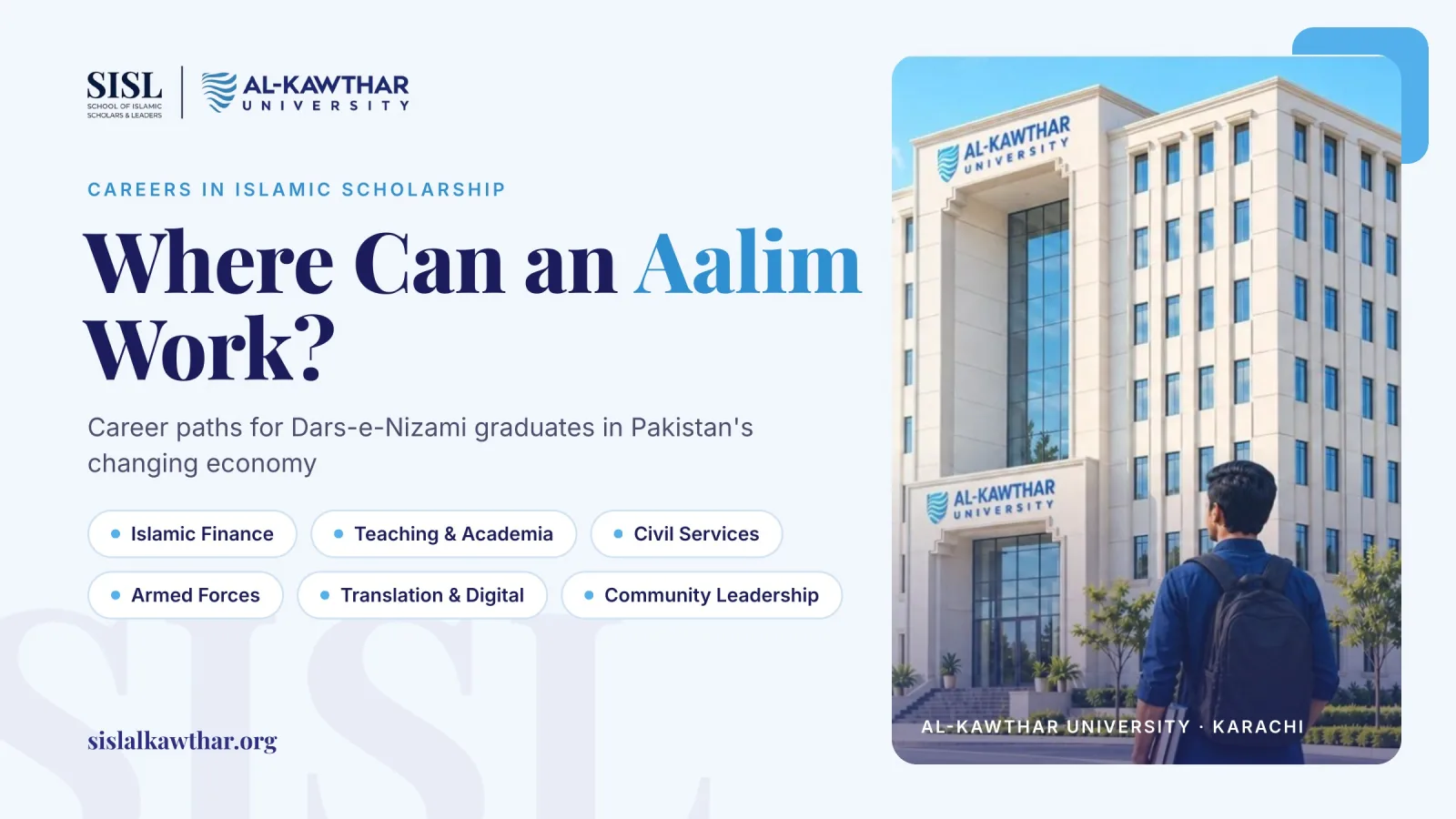
For generations, the answer to “what does an Aalim do after graduating?” seemed obvious: teach in a madrasa, lead prayers in a mosque, or both. Those roles remain at the heart of Muslim community life in Pakistan, and they always will. But the country around them has changed. New industries, new regulations and new public institutions now actively need people trained in the Islamic sciences, provided they also bring the formal qualifications and modern skills that these settings expect.
This article looks at six career paths open to Dars-e-Nizami graduates today, what each one actually requires, and what students can do now to prepare for them, including what to expect when applying to an integrated program.
1. Islamic Banking and Finance: The Fastest-Growing Field
No sector has grown faster for Islamic scholars than finance. According to Profit by Pakistan Today, Islamic banking already accounts for about 23% of banking assets, 28% of deposits and 38% of financing in Pakistan. As of December 2025, the industry included seven full-fledged Islamic banks and 16 conventional banks operating Islamic branches, with total assets of around Rs 14.5 trillion.
The direction of travel is clear. Following the Federal Shariat Court’s judgment of April 2022 and the 26th Constitutional Amendment, Pakistan has committed to eliminating riba from its financial system before 1 January 2028. The government’s transition plan covers not only banks but also insurers, mutual funds, Modarabas and other financial institutions, and it includes a capacity-building strategy for Shariah scholars, bank staff and auditors.
Every Islamic banking institution must have a Shariah Board of at least three scholars. The State Bank of Pakistan’s Shariah Governance Framework spells out who qualifies, and the requirements are revealing. A scholar needs either:
- Shahadat ul Aalamiya (Dars-e-Nizami) from a recognised board with at least 70% marks, plus a Bachelor’s degree with at least a second class, or
- a postgraduate degree in Shariah or Usooluddin, or an LLM (Shariah), from a recognised university.
On top of that, the framework requires several years of experience issuing Shariah rulings (including Takhassus fil Ifta) or teaching and researching Islamic finance, along with demonstrated competence in Usool al-Fiqh, Arabic and English, and an understanding of banking itself.
In other words, the most senior Shariah roles in Pakistan’s financial system ask for exactly the combination that a traditional madrasa education alone does not provide: a Sanad and a formal degree, classical fiqh and English, scholarship and real familiarity with how modern finance works. Beyond Shariah boards, Islamic banks also employ Shariah compliance officers, product development staff and Shariah auditors, all roles where scholarly training is a genuine advantage.
2. Teaching and Academia
Islamiat is a compulsory subject throughout Pakistan’s school and college system, which creates steady demand for qualified teachers. The Higher Education Commission formally recognises the Shahadat ul Aalamiya as equivalent to an MA in Arabic or Islamic Studies, and HEC states that this equivalence can be used for teaching Arabic and Islamic Studies and for pursuing higher studies.
However, obtaining the equivalence takes paperwork: verified certificates for each stage, IBCC equivalence for the earlier levels, and a fee. At the university level, the bar is rising further. Faculty positions increasingly expect an MS/MPhil or PhD, published research and the ability to teach and write in English. Graduates who hold a university degree from the start move into this path far more smoothly than those who must convert their credentials later.
3. Civil Services
Many families do not realise that the CSS examination is open to madrasa-educated candidates who also hold a recognised bachelor’s degree. Islamic Studies is one of the compulsory papers, an area where a Dars-e-Nizami graduate starts with a clear advantage. The upper age limit for CSS has also been raised from 30 to 35, giving students who spent extra years on religious studies more time to compete.
The challenge, again, lies elsewhere. CSS papers are written in English, and the exam now begins with an MCQ-based preliminary test before the written stage. A strong command of English, current affairs and general knowledge matters as much as religious scholarship.
4. Religious Teachers in the Armed Forces
Pakistan’s armed forces recruit religious teachers (Khateebs) to serve their personnel. According to recruitment guides for the Pakistan Army’s Naib Khateeb post, candidates need Dars-e-Nizami (Shahadat ul Aalamiya) from a recognised board along with at least an FA or FSc, and are inducted as Junior Commissioned Officers. The age limit is typically 20 to 28, and there are physical fitness requirements. Applicants should always confirm current criteria on the official Join Pak Army portal.
This path rewards graduates who completed their formal schooling alongside their religious studies, and who kept up their physical fitness.
5. Translation, Research and Digital Content
Arabic is a skill with value well beyond the madrasa. Translation of religious, legal and commercial texts; research support for academics and think tanks; and the growing world of Islamic digital content, from YouTube channels and podcasts to educational apps, all need people who can read classical sources accurately.
Technology is opening new doors here too. AI-assisted research tools built on the Quran, Hadith and Fiqh literature need scholars to verify sources, review answers and guide development. Graduates who combine textual expertise with digital literacy, writing ability and some familiarity with research tools are well placed for this kind of work.
6. Mosque, Madrasa and Community Leadership
None of this diminishes the traditional paths. Imams, khateebs and madrasa teachers remain the backbone of religious life in Pakistan, and communities need them to be well trained. What is changing is the setting: congregations today include university students, professionals and families facing questions shaped by social media, finance, technology and life abroad. Scholars who can communicate clearly, understand those contexts and speak with confidence in public serve their communities better.
What These Paths Have in Common
Look across all six careers and a pattern appears:
| Career path | Sanad helps | Also needed |
|---|---|---|
| Islamic finance | Shahadat ul Aalamiya (70%+) | Bachelor’s degree, English, finance knowledge, Ifta experience |
| Teaching & academia | HEC equivalence to MA | MS/PhD, research, English |
| Civil services | Strong in Islamic Studies paper | Bachelor’s degree, English, general knowledge |
| Armed forces | Shahadat ul Aalamiya | FA/FSc, physical fitness |
| Translation & digital | Arabic, textual skills | Writing, digital literacy |
| Community leadership | Core scholarship | Communication, modern context |
The Sanad matters in every case, but it is rarely enough on its own. The graduates with the widest choices are those who also hold a recognised degree, communicate well in English and have practical skills.
How Students Can Prepare
Earn a recognised degree alongside your studies. Whether through private exams, a university program or an integrated course, a formal degree removes the biggest barrier to finance, academia and the civil service.
Take English seriously. It appears as a requirement in almost every path above, from Shariah board competence to CSS papers.
Specialise after the Alim course. Takhassus fil Ifta is specifically preferred by the State Bank’s framework for Shariah scholars, and an MS or PhD opens academic doors.
Learn the field you want to enter. Aspiring Shariah advisors should study modern banking and finance; aspiring lecturers should start writing and researching early.
Applying to an Integrated Program: What to Expect
For students who want the Sanad and a recognised degree in one structured path, integrated programs are now an option. Admission to these programs usually looks different from a traditional madrasa intake, so it helps to know what to expect.
Take the School of Islamic Scholars & Leaders (SISL) at Al-Kawthar University in Karachi as an example. Its 8-year Islamic Scholar & Leaders Program combines Dars-e-Nizami with HEC-recognized BS and MS degrees in Islamic Studies, along with English, IT and leadership training, and offers an optional two-year Mufti specialisation after the Alim course.
Eligibility
- Minimum age of 16 years
- Intermediate, A-Levels or equivalent
- Students who have completed Matric or O-Levels may be offered conditional admission
The admission process
- Online application: personal and academic details, the program of interest, and a CNIC, B-Form or passport number for overseas students
- Document submission: transcripts, certificates and ID proof
- Interview: selection is based on an interview with the admissions committee; there is no written entrance test
- Result and enrollment: the admission decision, followed by fee submission to confirm a place
SISL has announced that its Spring 2027 admissions are opening soon, and families can book a campus visit before applying. Details are on the SISL admissions page.
Questions to ask any program before applying
- Which Wifaq or board will award the Sanad, and at which stages?
- Is the university degree HEC-recognized, and which university awards it?
- How are the religious and academic workloads balanced across the years?
- What English, IT and practical skills are taught, and how are they assessed?
- Who are the teachers, and what are their scholarly and academic backgrounds?
- What are the total fees, and are scholarships or financial aid available?
Visiting the campus, meeting teachers and speaking with current students can answer many of these questions better than any brochure.
Final Thoughts
Pakistan’s move towards a riba-free financial system, the rising demand for qualified Islamiat teachers and the expanding digital world are all creating real opportunities for Islamic scholars. Whether graduates can take them depends less on how much they know about the deen, and more on whether they can also show the degree, the language skills and the professional readiness that these new settings require. For students starting their journey today, planning for both from the first year may be the most important decision they make.
0 comments
Log in to leave a comment.
Be the first to comment.