
What Is a Data Enrichment API? A Complete Guide for Businesses
Learn what a data enrichment API is, how it works, its benefits, types, and use cases for person enrichment, email enrichment, and B2B lead generation.

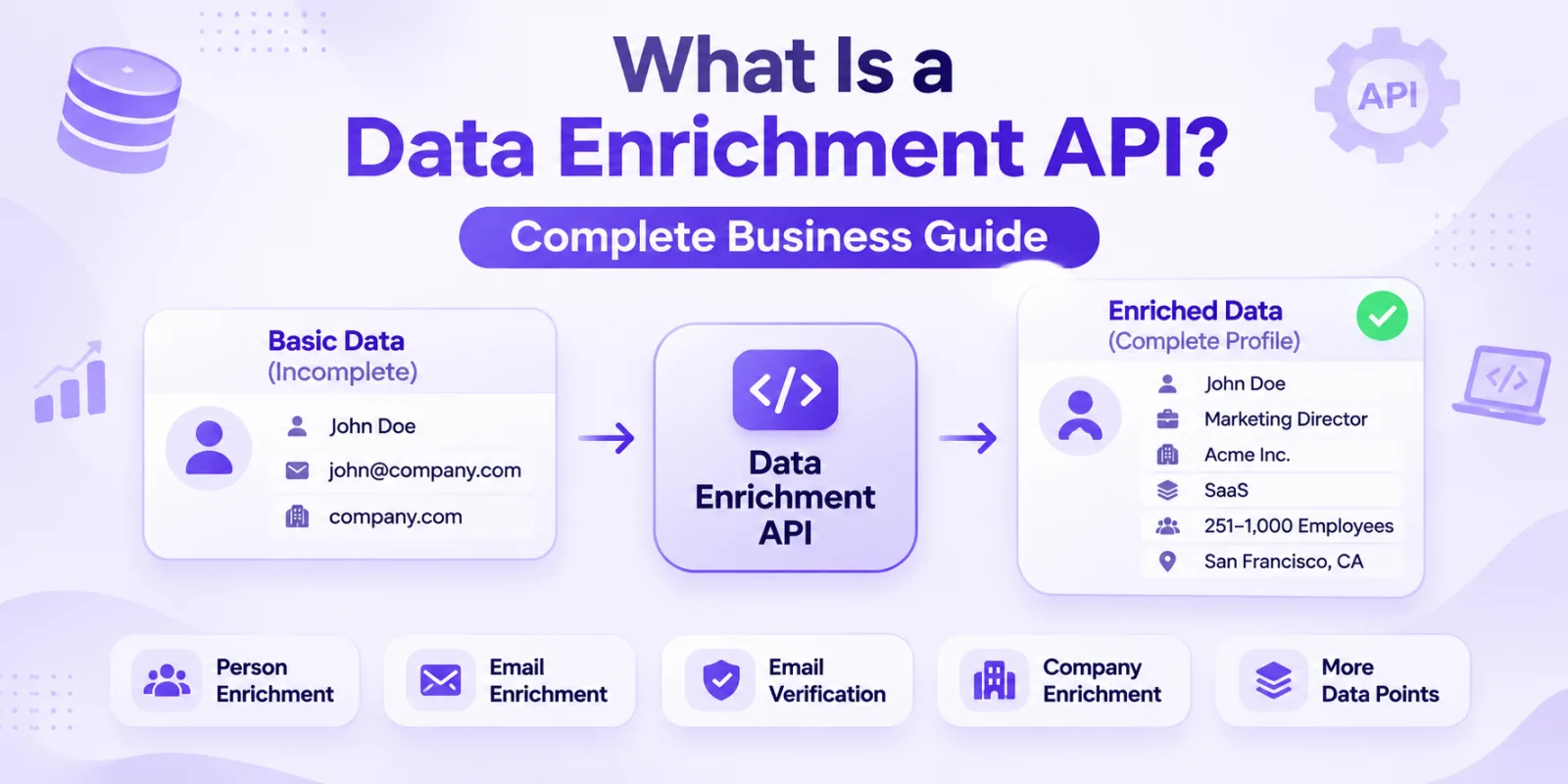
This is where a Data Enrichment API becomes useful. It helps businesses enhance existing records by adding relevant information such as professional details, company information, job titles, email addresses, and other valuable data points.
Instead of manually researching every prospect, businesses can use a data enrichment tool to automate the process and improve the quality of their databases.
In this guide, we will explain what a data enrichment API is, how it works, its major types, benefits, use cases, and how businesses can choose the right solution.
What Is a Data Enrichment API?
A Data Enrichment API is an application programming interface that helps businesses enhance existing records by adding additional information from available data sources.
For example, imagine your CRM contains a prospect's email address and company domain but does not include their job title, company size, industry, or professional profile. A data enrichment API can use the available information to retrieve relevant additional details and return an enriched record.
Depending on the provider and available data, enrichment can include:
Full names and professional details
Business email addresses
Job titles and departments
Company names and websites
Company size and industry
Employee information
Company locations
Professional social profile information
Funding and business information
The main purpose of a data enrichment API is to transform incomplete records into more useful business information.
For B2B companies, this is particularly valuable because accurate prospect data supports lead generation, account-based marketing, sales outreach, and customer relationship management.
How Does a Data Enrichment API Work?
A data enrichment API generally works by accepting an existing identifier, searching available data sources, matching relevant records, and returning additional information.
Although the exact process varies between providers, most enrichment workflows follow a similar structure.
1. Submit Existing Information
The process begins when a business provides an identifier through an API request. This could be an email address, company domain, professional profile URL, or another supported identifier.
For example, a business might submit:
An individual's email address
A person's name and company
A company website URL
A company domain
The quality of the input data can influence the accuracy of the matching process.
2. Data Matching and Identification
After receiving the request, the API attempts to identify a matching person or company using its available data sources.
It may compare identifiers, professional information, company domains, and other relevant attributes to find a suitable match.
Reliable matching is important because incorrect matches can introduce inaccurate information into business databases.
3. Retrieve Additional Information
Once a relevant match is identified, the API retrieves available information associated with that record.
For example, a person enrichment request might return a professional's name, current job title, company, and other available profile details.
Similarly, company enrichment can return firmographic information such as industry, employee count, location, and company description.
4. Return Enriched Data
The API returns the available information in a structured response, commonly using JSON.
Businesses can then integrate the response into their CRM, sales platforms, internal databases, or marketing automation systems.
5. Use the Data in Business Workflows
Once the information is enriched, teams can use it to segment prospects, personalize outreach, qualify leads, and improve sales processes.
This automated workflow reduces repetitive research and helps teams work with more complete business records.
Types of Data Enrichment APIs Businesses Should Know
Different businesses require different types of information. Some need professional contact details, while others focus on company intelligence or email accuracy.
Understanding the major types of data enrichment APIs helps businesses select the right solution.
1. Person Enrichment API
A person enrichment API adds professional information to existing individual contact records.
For example, a sales team might have a person's business email address but lack information about their current position or employer.
Using person enrichment, businesses can potentially retrieve:
Full name
Current job title
Company name
Professional experience
Department
Professional profile information
Location
Person enrichment is particularly useful for sales development representatives, recruiters, marketing teams, and B2B businesses.
It helps teams understand who they are contacting and whether that individual matches their ideal customer profile.
2. Email Enrichment API
Email enrichment focuses on adding useful information to existing email records.
For example, a business may have a list of email addresses collected through website registrations, lead generation campaigns, or customer interactions.
An email enrichment API can help identify associated professional or company information when a reliable match is available.
Common enrichment attributes may include:
Associated person's name
Company name
Company domain
Professional role
Available contact information
Email enrichment helps businesses transform basic email lists into more informative contact databases.
It can also support lead qualification and personalized email marketing campaigns.
3. Company Enrichment API
A company enrichment API adds business information to existing company records.
Businesses can often use a company domain or website as an input to retrieve relevant company information.
Depending on the provider, enriched company records may include:
Company name
Website URL
Industry
Employee count
Company size
Headquarters location
Company description
Available funding information
This information helps sales teams identify target accounts and understand the businesses they want to approach.
4. Email Verification API
Email verification is closely related to data enrichment, but both serve different purposes.
An email verification API checks whether an email address appears valid and deliverable based on available technical and verification signals.
It may identify:
Invalid email addresses
Disposable email addresses
Incorrect email formatting
Domain and mail server issues
Catch-all email configurations
Potentially risky addresses
Email verification tools are useful for maintaining cleaner contact databases and reducing unnecessary email bounces.
Businesses should remember that verification results are not an absolute guarantee of inbox delivery. Mail server configurations and recipient-side policies can change.
5. Employee Enrichment API
An employee enrichment API helps businesses discover available professional information associated with employees at a company.
For example, a sales team targeting a software company may want to identify its marketing managers, sales directors, or technology decision-makers.
Employee enrichment can help retrieve relevant information such as names, job titles, departments, and associated company details, depending on data availability.
It is especially useful for account-based marketing, recruitment, and B2B prospecting.
Data Enrichment API vs. Data Enrichment Tool: What's the Difference?
A data enrichment API and a data enrichment tool have similar objectives, but they serve different workflows.
A data enrichment API is primarily designed for developers and businesses that want to integrate enrichment capabilities directly into their existing applications.
A data enrichment tool generally provides a ready-to-use interface where users can upload records, search for information, or enrich contact databases without building a custom integration.
Here is a simple comparison:
For example, a SaaS company building its own prospecting platform may prefer an API because it can integrate enrichment directly into its application.
A small sales team may prefer a ready-made data enrichment tool because it can enrich records without additional development work.
Some providers offer both API access and user-friendly interfaces.
Key Benefits of Using a Data Enrichment API
Using a data enrichment API can improve how businesses collect, organize, and use information. Here are some of its most important benefits.
1. Improve Data Accuracy
Incomplete and outdated records can create problems across sales and marketing operations.
An enrichment API helps businesses add available information to existing records, making their databases more useful.
When combined with email verification tools and regular database maintenance, enrichment can also support better overall data quality.
2. Save Time on Manual Research
Sales teams often spend considerable time researching prospects before contacting them.
They may need to find job titles, company information, professional backgrounds, and business contact details.
A data enrichment API automates many of these research activities, allowing employees to focus more on selling and customer relationships.
3. Improve Lead Generation
Lead generation becomes more effective when businesses understand their prospects.
For example, knowing a prospect's company size, industry, and job title can help sales teams determine whether that person matches their ideal customer profile.
Enriched records can support better lead qualification and segmentation.
4. Personalize Sales Outreach
Generic sales emails often fail to communicate why a product or service is relevant to a particular prospect.
Enriched information gives sales teams more context about their audience.
They can use available job titles, company details, and professional information to create more relevant messages.
However, businesses should always follow applicable privacy regulations and outreach requirements.
5. Maintain Better CRM Records
Customer relationship management systems can gradually accumulate incomplete, duplicated, and outdated records.
A data enrichment tool can help fill information gaps and support database maintenance.
Better-organized CRM records make it easier for sales teams to manage accounts, prioritize prospects, and maintain consistent workflows.
6. Support Business Automation
APIs allow businesses to connect data enrichment capabilities with their existing applications.
For example, a company can create a workflow where a new lead is automatically enriched after entering its CRM.
This reduces repetitive tasks and helps teams process records more efficiently.
Common Use Cases of Data Enrichment APIs
Data enrichment APIs are useful across different industries and business operations.
B2B Lead Generation
B2B companies can enrich basic prospect records with available professional and company information.
This helps sales teams identify potential customers and prioritize high-value opportunities.
Sales Intelligence
Sales representatives can use enriched company and person information to understand their target accounts.
For example, knowing a company's industry, size, and available employee information can help sales teams prepare more relevant conversations.
Recruitment and Talent Acquisition
Recruitment platforms can use person enrichment to supplement candidate records with available professional information.
This can help recruiters organize candidate databases and understand relevant career details.
CRM Data Management
Businesses can integrate enrichment APIs into their CRM systems to improve the completeness of contact and company records.
This can support better segmentation, reporting, and account management.
Marketing Automation
Marketing teams can use enriched information to create more relevant audience segments.
For example, a campaign targeting SaaS founders can use available company and professional attributes to identify suitable contacts.
Account-Based Marketing
Account-based marketing requires businesses to understand their target companies and relevant decision-makers.
Company enrichment and person enrichment can help teams build more complete account profiles and identify relevant contacts.
How to Choose the Right Data Enrichment API
Choosing a data enrichment API requires more than comparing pricing plans. Businesses should evaluate the quality, availability, and usability of the data.
Here are some important factors to consider.
1. Data Coverage
Check whether the provider supports the countries, industries, and types of contacts relevant to your business.
An API with strong coverage in one region may have limited information in another.
2. Available Enrichment Fields
Different providers offer different data attributes.
Check whether the API supports the information you need, such as professional details, company information, email enrichment, employee records, or funding data.
3. API Documentation
Clear documentation makes implementation easier for developers.
Look for authentication instructions, endpoint descriptions, request examples, response formats, error handling, and rate-limit information.
4. Data Accuracy and Freshness
Data quality is one of the most important factors.
Evaluate how the provider handles record matching, data updates, missing fields, and incorrect information.
Do not assume that every returned field is guaranteed to be current or accurate.
5. Scalability and Performance
Consider whether the API can support your expected request volume.
Businesses processing thousands of records may need different rate limits and infrastructure capabilities than businesses making occasional enrichment requests.
6. Security and Compliance
Business data processing should follow relevant privacy and data protection requirements.
Review the provider's security practices, data sources, retention policies, and compliance documentation before integrating an API into your systems.
7. Pricing and Integration Flexibility
Compare pricing based on credits, API requests, enrichment types, or subscription plans.
Also consider whether the provider supports the programming languages and systems used by your development team.
How EnrichmentAPI Helps Businesses Enrich Their Data
Businesses looking for a practical way to improve their B2B databases can explore EnrichmentAPI.
EnrichmentAPI provides API-based data enrichment capabilities designed to help businesses retrieve additional information about people, companies, and professional contacts.
Instead of manually researching individual records, businesses can use its enrichment capabilities to support automated data workflows.
Some of the key enrichment areas to explore include:
Person Enrichment: Supplement existing contact records with available professional information.
Company Enrichment: Retrieve useful company details using supported business identifiers.
Email Enrichment: Add relevant information to existing email records.
Email Verification: Help assess email address validity and quality.
Employee Information: Discover available employee and professional details.
Company Funding Information: Access available funding-related company data.
These capabilities can be useful for sales teams, marketing agencies, recruitment platforms, SaaS businesses, and developers building data-driven applications.
By integrating enrichment into existing workflows, businesses can reduce manual research and make better use of the information already available in their databases.
Visit EnrichmentAPI to explore its data enrichment capabilities and API documentation.
Common Challenges in Data Enrichment
Although data enrichment offers several advantages, businesses should understand its limitations before implementing it.
Incomplete Data Availability
Not every person or company will have complete information available. Some records may return only a few matching attributes.
Incorrect Record Matching
If the input information is inaccurate or ambiguous, an API may struggle to identify the correct person or company.
Businesses should validate important records before using them in critical workflows.
Data Privacy Concerns
Organizations must ensure that their data collection, enrichment, storage, and usage practices comply with applicable privacy laws and regulations.
Integration Complexity
Custom API integrations may require development resources, testing, authentication management, and ongoing maintenance.
Choosing a provider with clear documentation can make implementation easier.
Frequently Asked Questions (FAQs)
1. What Is a Data Enrichment API Used For?
A data enrichment API is used to enhance existing records with additional information about people, companies, and professional contacts. Businesses use it for lead generation, CRM management, sales intelligence, and marketing automation.
2. How Does a Data Enrichment API Work?
It accepts an identifier such as an email address, company domain, or professional profile URL. The API attempts to match the input against available data sources and returns relevant information in a structured format.
3. What Is the Difference Between Person Enrichment and Company Enrichment?
Person enrichment focuses on individual professional information, such as names, job titles, and associated companies. Company enrichment focuses on business information, such as industry, employee count, company website, and headquarters.
4. Is Email Enrichment the Same as Email Verification?
No. Email enrichment adds associated information to an email record, while email verification checks the validity and potential deliverability of an email address.
5. Can a Data Enrichment API Integrate With a CRM?
Yes. Businesses can integrate a data enrichment API with supported CRM systems through custom development or automation platforms. This allows them to enrich new or existing contact records automatically.
6. Who Should Use a Data Enrichment API?
B2B sales teams, marketing agencies, SaaS companies, recruitment platforms, developers, and businesses managing large contact databases can benefit from data enrichment APIs.
7. Is a Data Enrichment API Suitable for Small Businesses?
Yes. Small businesses can use enrichment APIs to improve prospect information, reduce manual research, and organize their sales databases. The right solution depends on their data requirements and budget.
Conclusion
A Data Enrichment API helps businesses turn incomplete contact and company records into more informative datasets. By adding available professional, business, and email-related information, organizations can improve lead generation, sales intelligence, CRM management, and marketing automation.
Whether a business needs person enrichment, email enrichment, company information, or email verification tools, choosing the right data enrichment solution can make its data workflows more efficient.
For businesses looking to automate these processes, EnrichmentAPI offers enrichment capabilities that can help retrieve useful information and support data-driven operations.
Explore EnrichmentAPI to learn how API-powered data enrichment can support your business growth.
0 comments
Log in to leave a comment.
Be the first to comment.