
Wellness Marketing Company: How to Choose One That Actually Fits Your Business

Wellness marketing carries stakes most industries don't. The FTC's Endorsement Guides require that testimonials and influencer content reflect honest, substantiated experiences, and the FDA restricts what health-related benefit claims a business can make without evidence. If your business handles protected health information — telehealth intake forms, for example — HIPAA applies too. A generic agency that doesn't understand these boundaries can create real legal exposure, not just a weak campaign.
The right wellness marketing company depends on your business model — a yoga studio, a spa, a clinic, and a wellness product brand each need a different mix of SEO, content, paid media, and compliance, not the same generic package.
That's the real filter for choosing a partner: not "do they offer SEO," but "do they understand wellness well enough to grow you without putting you at risk."
What Does a Wellness Marketing Company Actually Do?
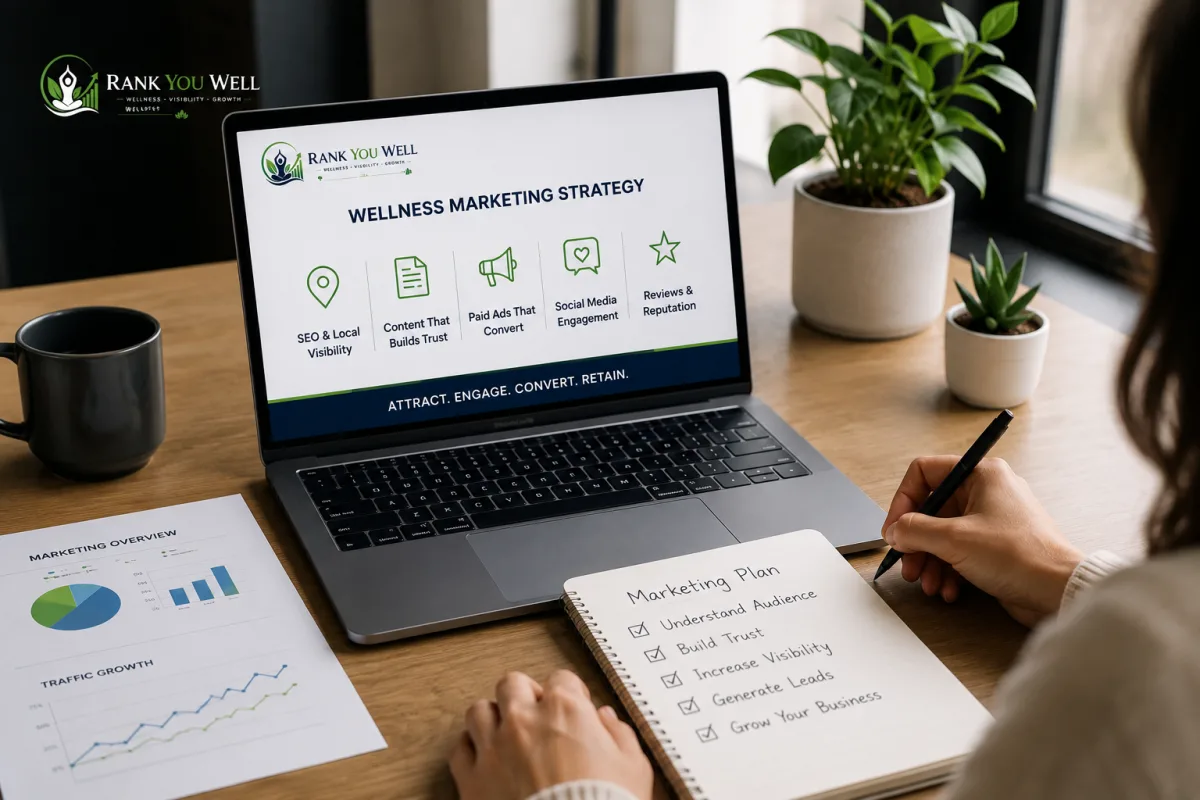
It combines SEO, local search, content, paid advertising, and compliance-aware messaging to turn visibility into bookings, memberships, or sales — the mix depends on what you sell.
Most wellness marketing draws from:
SEO and local SEO (Google Business Profile, service pages, location pages)
Content marketing built around real customer questions
Paid search and social advertising
Social media and community building
Website conversion optimization
Reputation and review management
AI search / GEO optimization
You rarely need all of it at once. A good company identifies where your customers are actually coming from and where they drop off — not by pitching every service on the list.
Strategy Should Match Your Business Model
There's no single wellness marketing formula. What works changes by business type:
Yoga studios and fitness centers rely on "near me" and Google Maps visibility, class or membership pages, and reviews — turning a nearby search into a booked trial.
Spas and med-spas need treatment-specific pages and Google Ads matched to exact intent ("deep tissue massage near me" converts very differently than a general wellness article).
Nutrition coaches and therapists need content that demonstrates expertise and answers objections before a first consultation.
Wellness clinics need the heaviest compliance layer: FTC-compliant testimonials, accurate claims, and conversion optimization built on trust, not urgency.
Wellness product brands need ecommerce SEO, creator partnerships, retargeting, and retention — closer to standard DTC marketing than local service marketing.
Matching strategy to business model, not applying a template, is the biggest differentiator between agencies that work and ones that don't.
What Should It Cost?
Budgets vary widely, but startups often invest 15–25% of revenue in marketing, while established wellness brands typically run closer to 8–12%, split across paid acquisition and organic channels like SEO and content.
Monthly retainers commonly range from a few thousand dollars for small, single-location businesses to well into five figures for multi-location or ecommerce brands with heavier content and advertising needs. Don't evaluate an agency on fee alone — ask exactly what you're getting and how results will be measured.
How Long Does It Take to Work?
Paid advertising can generate activity within weeks, but SEO and organic visibility typically take three to six months to build meaningfully, with stronger results compounding after a year.
A realistic timeline: month one is audit, research, and measurement setup; the next one to two months build out pages, content, and campaigns; ongoing months review and expand what's working.
Be skeptical of anyone promising fast rankings — organic growth compounds, it doesn't spike.
Compliance and Evaluation Checklist
A wellness-aware agency should already understand FTC Endorsement Guides for testimonials, FDA restrictions on health benefit claims, HIPAA (if you handle protected health information), and platform ad policies that restrict certain health-related targeting. If their first pitch is volume — "20 posts a month" — without asking about your claims or compliance needs, that's a warning sign.
Before hiring, ask:
Do they understand your specific niche, not just "wellness" broadly?
Can they show real outcomes — bookings, leads, revenue — not just traffic or rankings?
Do they raise compliance unprompted?
Do they have a clear first-90-days process with defined phases, rather than vague promises?
Frequently Asked Questions
What is a wellness marketing company?
An agency that helps wellness businesses attract, convert, and retain customers through SEO, content, local search, paid advertising, and compliance-aware messaging tailored to health and wellness audiences.
How much should I budget for wellness marketing?
Newer businesses often spend 15–25% of revenue; established brands spend closer to 8–12%, split between paid and organic channels — actual numbers depend on competition and growth goals.
How long until wellness marketing shows results?
Paid campaigns can generate activity within weeks; SEO and content typically need three to six months to build traction, compounding further after a year.
Does wellness marketing need to follow specific regulations?
Yes. Health-related claims fall under FTC and FDA oversight, and HIPAA applies if your business handles protected health information — this should be built into the agency's process, not treated as an afterthought.
Is a wellness marketing company different from a general agency?
It should be. A wellness-specialized company understands trust-driven buying behavior, regulatory boundaries, and business-specific journeys — a studio's path to booking looks nothing like a clinic's or a product brand's.
Final Takeaway
The right wellness marketing company isn't the one with the longest service list — it's the one that builds a strategy around your specific business model, respects the compliance rules your industry actually operates under, and can show real outcomes, not just rankings. Start by asking any agency you're evaluating one question:
What changes about your approach for a business like mine? If the answer stays generic, the results usually will too. Rank You Well builds wellness marketing strategy around the business first — matching SEO, content, local search, and paid media to what a yoga studio, clinic, or product brand each actually need to grow, with compliance built in from the start.
0 comments
Log in to leave a comment.
Be the first to comment.