
The Economics of the Six-Pack Ring: Why Plastic Still Wins on Cost-Per-Unit
A cost-per-unit breakdown of material, freight, and line-speed economics — and why plastic carriers still come out ahead once the full picture is priced in.

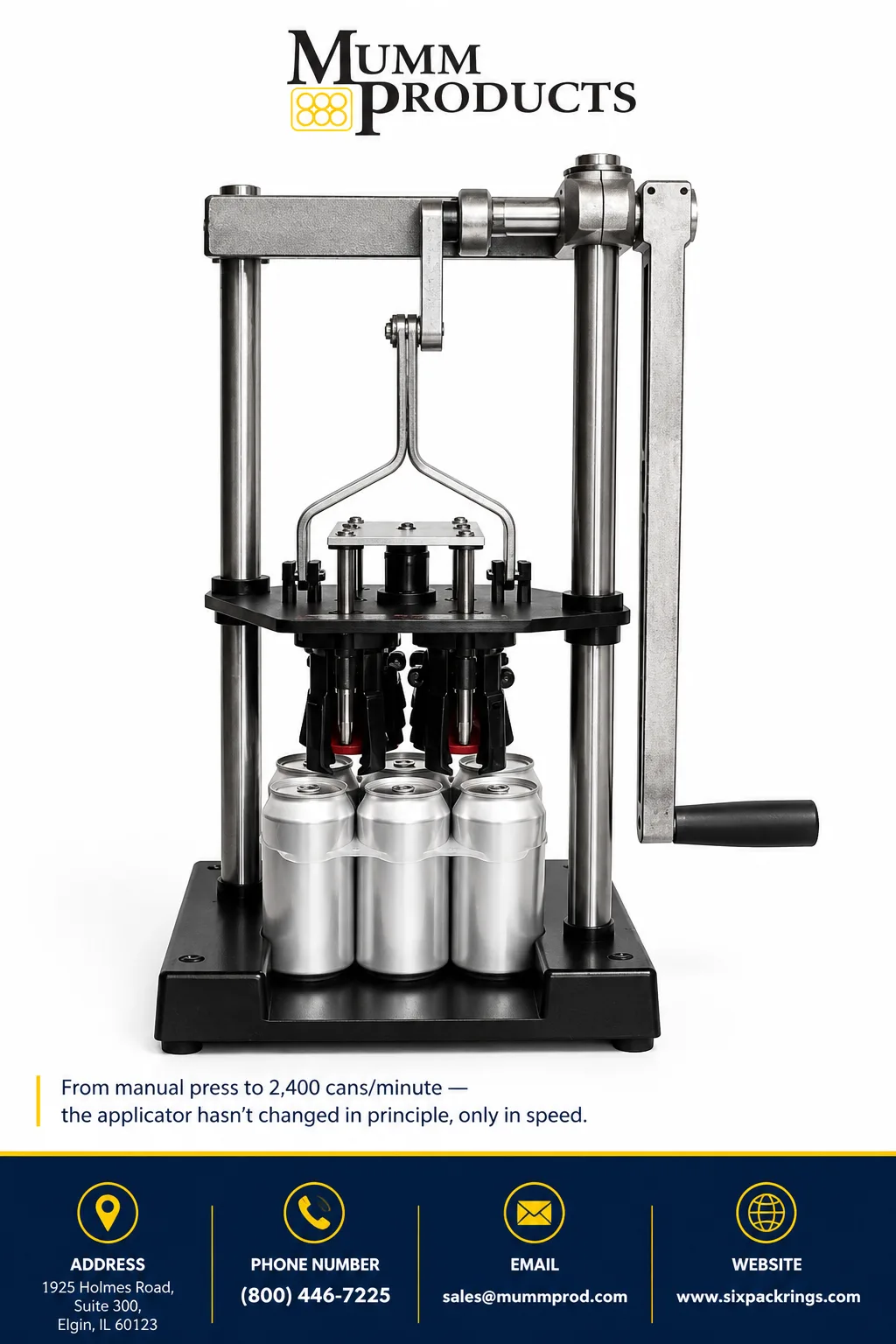
Ask a beverage company's procurement team why they still use plastic ring carriers instead of paperboard, 6 packer, wire, or glue-based alternatives, and the answer rarely has anything to do with tradition. It comes down to a spreadsheet. When you run the numbers per unit, per pallet, and per production hour, plastic ring carriers remain one of the hardest formats to beat on total cost — and understanding why requires looking past the sticker price of the material itself.
At the material level, the math is straightforward. Standard polyethylene ring carriers typically cost in the range of $0.06 to $0.12 per unit in bulk production, compared with paperboard-based carriers, which commonly run $0.20 to $0.25 per unit or more. That's a gap of roughly two to four times the cost, purely on raw material and manufacturing basis — before shipping, storage, or line performance are even factored in.
For a mid-size beverage producer running a few million units a year, that difference isn't a rounding error. A gap of even $0.10 per six-pack, multiplied across 10 million units annually, works out to a $1 million swing in packaging spend — money that goes straight to margin or gets reinvested elsewhere in the business.
The cost advantage isn't accidental — it comes from how the material is made and used. Ring carriers are produced through a simple extrusion process using low-density polyethylene (LDPE), a material that requires comparatively little raw input per unit and can incorporate a high share of recycled content without losing the tensile strength needed to hold a can securely through transport. Paperboard carriers, by contrast, require more raw material by weight to achieve equivalent load-bearing strength, along with adhesives or coatings for moisture resistance — both of which add cost.
Weight is the other half of the story. A plastic ring carrier weighs a fraction of what a paperboard equivalent does for the same six-can load. That matters more than it sounds like it should, because beverage companies aren't just paying for packaging material — they're paying to ship it, on every truck, every pallet, every mile. Lighter packaging means more product per shipment at the same freight cost, and that advantage compounds every time a truck leaves the warehouse.
Material cost is only one line in the budget. The bigger, less visible cost driver is what happens on the production floor.
Modern automated carrier-application equipment is built to run on high-speed canning lines, with commercial systems capable of applying carriers at rates approaching 2,400 cans per minute. Plastic ring carriers are engineered specifically to perform at that speed — consistent tension, predictable stretch, minimal jamming.
A packaging format that can't keep pace with that throughput doesn't just cost more per unit; it costs the plant in reduced output, more downtime for adjustments, and higher labor overhead per case produced.
This is the calculation that rarely shows up in a simple "cost per carrier" comparison but dominates real procurement decisions: a carrier that's marginally cheaper per unit but shaves even a few percentage points off line speed can end up costing more overall once you price in lost throughput on a facility running around the clock.
The economics have shifted further in plastic's favor over the past decade as recycled-content formulations have matured. Post-consumer recycled (PCR) resin blends — some now used at 50% or more of total material — allow manufacturers to hold material costs steady or even reduce them, since recycled feedstock is frequently cheaper to source than virgin resin, while also strengthening a brand's sustainability reporting.
Industry data on PCR production shows meaningful reductions in energy and water use compared with virgin material production, which increasingly translates into lower per-unit manufacturing cost as recycling infrastructure scales.
In other words, the "sustainable" version of a plastic ring carrier isn't a cost premium anymore in most cases — it's frequently the cheaper option, which is part of why adoption has moved so quickly across the industry without needing regulatory pressure to drive it.
Packaging cost conversations often get flattened into a single number: price per unit. But for beverage manufacturers running high-volume lines, the real comparison spans material, freight, labor, and throughput — and on that fuller accounting, plastic ring carriers have held their cost advantage for over sixty years, not because the format has resisted change, but because it has kept adapting — lighter, faster to apply, and increasingly built from recycled material — while staying cheaper than the alternatives at every stage of the supply chain.
The Per-Unit Number That Sets the Baseline
At the material level, the math is straightforward. Standard polyethylene ring carriers typically cost in the range of $0.06 to $0.12 per unit in bulk production, compared with paperboard-based carriers, which commonly run $0.20 to $0.25 per unit or more. That's a gap of roughly two to four times the cost, purely on raw material and manufacturing basis — before shipping, storage, or line performance are even factored in.
For a mid-size beverage producer running a few million units a year, that difference isn't a rounding error. A gap of even $0.10 per six-pack, multiplied across 10 million units annually, works out to a $1 million swing in packaging spend — money that goes straight to margin or gets reinvested elsewhere in the business.
Why the Gap Exists: It's a Materials Story
Weight is the other half of the story. A plastic ring carrier weighs a fraction of what a paperboard equivalent does for the same six-can load. That matters more than it sounds like it should, because beverage companies aren't just paying for packaging material — they're paying to ship it, on every truck, every pallet, every mile. Lighter packaging means more product per shipment at the same freight cost, and that advantage compounds every time a truck leaves the warehouse.
The Cost Nobody Puts on the Material Invoice: Line Speed
Modern automated carrier-application equipment is built to run on high-speed canning lines, with commercial systems capable of applying carriers at rates approaching 2,400 cans per minute. Plastic ring carriers are engineered specifically to perform at that speed — consistent tension, predictable stretch, minimal jamming.
A packaging format that can't keep pace with that throughput doesn't just cost more per unit; it costs the plant in reduced output, more downtime for adjustments, and higher labor overhead per case produced.
This is the calculation that rarely shows up in a simple "cost per carrier" comparison but dominates real procurement decisions: a carrier that's marginally cheaper per unit but shaves even a few percentage points off line speed can end up costing more overall once you price in lost throughput on a facility running around the clock.
Recycled Content Has Changed the Cost Equation Again
Industry data on PCR production shows meaningful reductions in energy and water use compared with virgin material production, which increasingly translates into lower per-unit manufacturing cost as recycling infrastructure scales.
In other words, the "sustainable" version of a plastic ring carrier isn't a cost premium anymore in most cases — it's frequently the cheaper option, which is part of why adoption has moved so quickly across the industry without needing regulatory pressure to drive it.
What the Full Cost Comparison Actually Looks Like
Put together, the total cost picture for plastic ring carriers breaks down into four stacked advantages:- Material cost — roughly half to a third the per-unit cost of paperboard alternatives.
- Freight and storage cost — lower weight per case means more units per shipment and less warehouse footprint per SKU.
- Line-speed cost — application equipment built for plastic carriers sustains higher throughput with fewer interruptions.
- Sustainability-adjusted cost — recycled-content formulations now close the gap between "cheap" and "sustainable," removing what used to be a trade-off.
0 comments
Log in to leave a comment.
Be the first to comment.