
Sports Technology Market Size, Growth Trends, Segmentation & Forecast 2026-2034
The global sports technology market size reached USD 23.8 Billion in 2025. Looking forward, IMARC Group expects the market to reach USD 51.6 Billion by 2034, exhibiting a growth rate (CAGR) of 8.52% during 2026-2034.

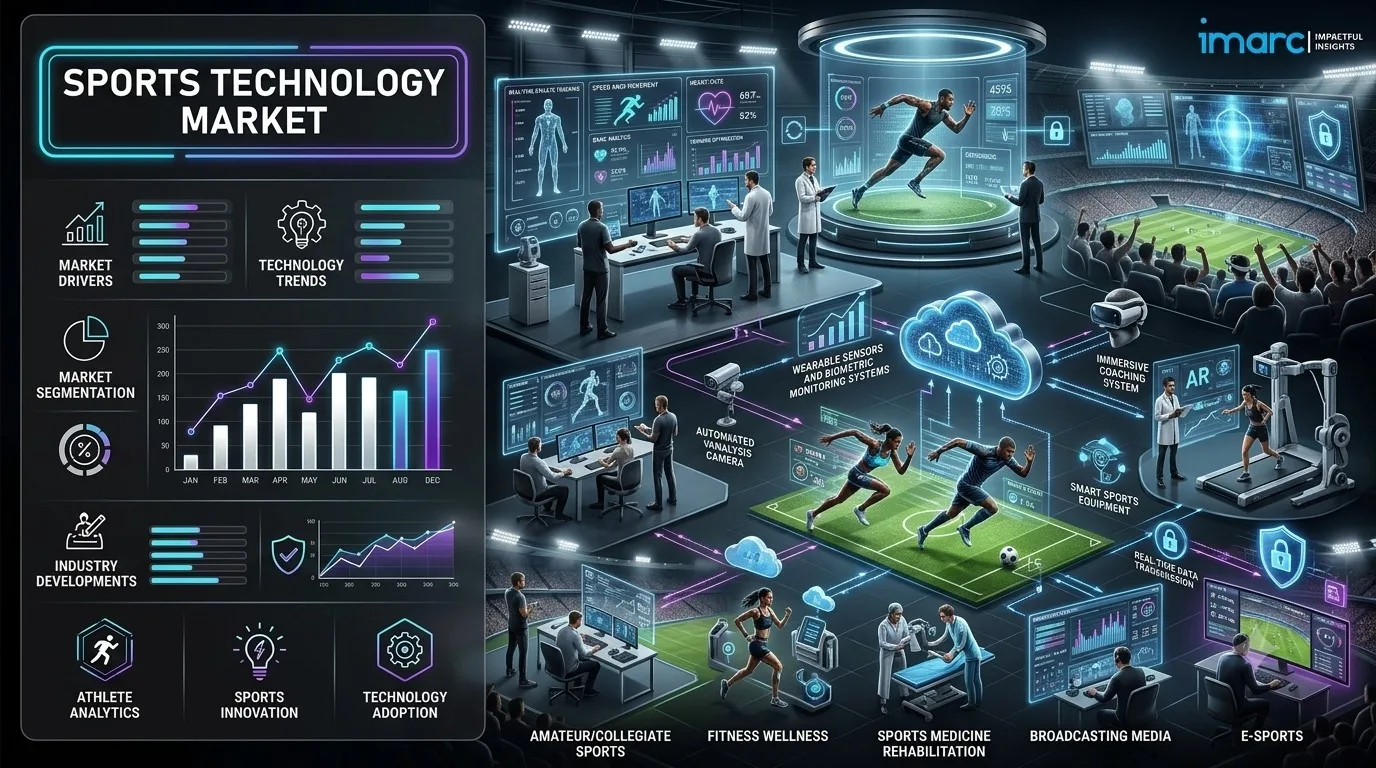
IMARC Group, a leading global market research and management consulting firm, has published its latest market intelligence report on the sports technology market. The global sports technology market size reached USD 23.8 Billion in 2025. Looking forward, IMARC Group expects the market to reach USD 51.6 Billion by 2034, exhibiting a growth rate (CAGR) of 8.52% during 2026-2034, with the industry demonstrating strong growth momentum driven by the high volume adoption of AI, IoT, and AR/VR technologies that are completely disrupting athlete performance analysis, fan engagement, and the operational efficiencies of sports organizations. The rising demand for personalized training programs and immersive fan experiences is creating a positive outlook for market expansion across the sports technology market.
The market is experiencing strong growth momentum driven by the increasing convergence of wearable technology, AI driven coaching tools, and AR/VR applications that are reshaping how athletes train, how coaches strategize, and how fans engage with live sport. This shift demonstrates a strategic response to the growing demand for data driven decision making across the sports industry. Wearable devices such as smartwatches, fitness bands, and GPS trackers continuously collect data on heart rate, distance covered, speed, and biomechanical movements, helping athletes tailor their training regimes while giving coaches and sports scientists the insights needed for injury prevention and tactical strategy. In August 2025, Zebra Technologies expanded its long standing NFL partnership by deploying its MotionWorks Sport RFID tracking system with the Indianapolis Colts to capture player and ball data during practice sessions, enhancing game strategy and player health monitoring. The broader trend towards more immersive, interactive fan experiences continues to create sustained demand for robust, intuitive sports technology solutions across professional and amateur sport alike. The global sports technology market size growth rate reflects strong expansion as sports organizations increasingly adopt AI, IoT, wearable devices, AR/VR, and real-time analytics to improve athlete performance and fan engagement.
How AI is Reshaping the Future of the Sports Technology Market
AI Powered Performance Analysis and Personalized Coaching: AI algorithms analyze vast amounts of data captured by sensors and cameras to identify patterns, predict outcomes, and recommend personalized action, with video analytical AI coaching platforms scoring athletes on form and providing continual learning feedback tailored to individual development needs.
Predictive Fan Engagement and Sports Management Optimization: In sports management, predictive AI is optimizing ticket price strategies, forecasting fan behavior, and efficiently managing inventory, while data analytics in sports broadcasting is generating additional statistics, interactive visualizations, and predictive insights that make the fan viewing experience richer and more engaging.
AI Driven Injury Prevention and Recovery Planning: AI integration into wearable and tracking systems is enhancing coaching capabilities through predictive analytics for injury risk assessment and performance forecasting, helping training staff identify fatigue levels and workload patterns before they translate into on field injuries.
Grab a sample PDF of this report: https://www.imarcgroup.com/sports-technology-market/requestsample
Sports Technology Market Trends and Drivers:
The global sports technology market is witnessing steady expansion, fueled by the convergence of wearable technology adoption, AI and data analytics integration, and the rise of VR and AR applications across training and fan engagement use cases. Wearables have revolutionized athlete performance monitoring, with devices continuously collecting biomechanical and physiological data that aid athletes in tailoring their training regimes and help coaches make informed decisions about health status and tactical strategy. In team sports such as soccer and basketball, wearable sensors track each player's movements, positioning, and fatigue levels, providing insights that enhance overall team performance. In September 2025, Garmin launched the Venu 4 smartwatch, featuring HRV status, training readiness, workout benefit and recovery time tracking, and wrist based running dynamics, extending the reach of consumer grade sports technology into everyday fitness and training routines.
AI along with data analytics has become indispensable in sports technology, with algorithms identifying patterns, predicting outcomes, and recommending personalized action across training, coaching, and broadcasting. In August 2024, Stats Perform launched OptaAI Studio, an AI powered platform combining natural language search, live dashboards, and automated graphics tools to help broadcasters, teams, and media organizations uncover contextual game insights from Opta's sports database, reflecting the wider industry shift towards AI assisted storytelling and analysis. Meanwhile, AR and VR applications are revolutionizing both sports training and fan engagement, allowing athletes to immerse themselves in simulated environments to hone their skills without real world risk, while AR overlays digital content such as player statistics and replays onto live broadcasts and stadium views to create more interactive viewing experiences.
Regionally, Europe and North America are leading the way in sports technology adoption, supported by a robust culture of sport, high investment in infrastructure, and innovation hubs for new technologies. In Europe, countries such as the United Kingdom, Germany, and France are at the forefront of adopting AI driven analytics, wearable devices, and VR and AR applications, with sports organizations increasingly investing in technology to gain competitive advantages and improve player development. The Asia Pacific region is also emerging as an important growth market, driven by rising sports participation rates and fast growing sports technology investment across countries including China and Japan.
Ask an analyst for customized report: https://www.imarcgroup.com/request?type=report&id=12539&flag=E
Sports Technology Industry Segmentation:
The report has segmented the market into the following categories:
Breakup By Component:
Software
Wearable devices and sports equipment
Services
Software represents the largest component segment, driven by sophisticated data processing functionality that enables real time analytics on player performance, injury trends, and game strategies. Performance analysis software processes biometric data from wearables to derive conditioning and recovery insights, while cloud based platforms enable seamless collaboration between coaches, athletes, and support staff across sports organizations.
Breakup By Technology:
Artificial intelligence/machine learning (AI/ML)
Internet of Things (IoT)
Augmented reality/virtual reality (AR/VR)
AI/ML is driving demand by enabling predictive analytics for performance insights, personalized coaching algorithms, and automated video analysis, while IoT devices support real time monitoring of athlete biometrics and equipment performance, and AR/VR technologies offer immersive training simulations and interactive fan experiences through virtual stadiums and broadcast overlays.
Breakup By Sports:
Soccer
Baseball
Basketball
Ice hockey
American Football/Rugby
Tennis
Cricket
Golf
Esports
Others
Soccer represents the leading sports segment, with demand driven by advanced analytics software that allows coaches to dissect player movements, passing accuracy, and positional play, along with wearable technology that provides real time fitness data for injury prevention and workload management.
Breakup By Application:
Tracking
Decision making and team analysis and management
Analytics and statistics
Tactics and simulation
Training
Game performance analysis and injury and health analysis
Tracking applications are driven by real time monitoring of athlete performance metrics such as speed and distance covered, while analytics and statistics tools process large datasets to uncover performance trends, and training applications are fueled by AI driven personalized programs that leverage wearable sensor data to optimize fitness routines.
Breakup By End User:
Coaches
Clubs
Leagues
Sports associations
Others
Coaches represent the largest end user segment, with demand driven by advanced analytics software that enables deep dives into player metrics such as speed, agility, and tactical decision making, supporting targeted training programs and personalized coaching strategies backed by predictive injury risk assessment.
Breakup By Region:
North America (United States, Canada)
Europe (Germany, France, United Kingdom, Italy, Spain, Others)
Asia Pacific (China, Japan, India, South Korea, Australia, Indonesia, Others)
Latin America (Brazil, Mexico, Others)
Middle East and Africa
Europe leads the global sports technology market, accounting for the largest regional share, driven by the continent's strong sporting culture, sustained investment in sports infrastructure, and a growing emphasis on performance analytics and fan engagement. European sports organizations and clubs are increasingly investing in technology to gain competitive advantages, improve player development, and manage operational efficiencies, with a rising trend toward integrating sports technology into grassroots and amateur sports as well.
Competitive Landscape:
The report provides a comprehensive analysis of the competitive landscape in the sports technology market with detailed profiles of all major companies, including:
Catapult Group International Ltd.
Garmin Ltd.
Infosys Limited
International Business Machines Corporation
Oracle Corporation
Pixellot Ltd.
SAP SE
Stats Perform
Zebra Technologies Corporation
The competitive landscape is characterized by intense innovation and strategic partnerships among key players aiming to capitalize on advancements in AI, IoT, and AR/VR. Leading companies dominate by offering comprehensive solutions for athlete performance analysis, fan engagement platforms, and sports management software, while technology giants are increasingly entering the market with AI powered solutions that optimize player training and health monitoring. Startups are also making significant strides by focusing on niche segments such as virtual training environments and esports analytics.
What Does The Full Report Cover?
If you are tracking the sports technology market for investment decisions, market entry planning, competitive benchmarking, or strategic advisory, IMARC Group's report gives you everything in one place:
Complete market sizing with revenue coverage across the full projection period
Quantified growth driver analysis with impact scoring across component, technology, sports, application, end user, and regional markets
Sub segment breakdowns for software, wearable devices and sports equipment, services, AI/ML, IoT, AR/VR, and individual sports categories with share data
Country level data for the United States, Canada, Germany, France, the United Kingdom, Italy, Spain, China, Japan, India, South Korea, Australia, Indonesia, Brazil, and Mexico
Competitive profiles of leading companies with strategic landscape assessment
Porter's Five Forces, value chain analysis, and pricing intelligence
Latest product innovation trends covering AI driven coaching platforms, wearable biometric monitoring, and AR/VR training and fan engagement applications shaping market competition across key regional markets
Recent News and Developments in Sports Technology Market
September 2025: Garmin launched the Venu 4 smartwatch, featuring HRV status, Body Battery, training readiness, workout benefit and recovery time tracking, and wrist based running dynamics, extending advanced training and wellness monitoring capabilities to a broader consumer audience.
August 2025: Zebra Technologies announced a new collaboration with the NFL's Indianapolis Colts, deploying its MotionWorks Sport RFID tracking system to monitor player and ball data during practice sessions, enabling insights that enhance game strategies and support player health and safety.
August 2024: Stats Perform launched OptaAI Studio, a three in one AI powered platform combining a natural language search tool, a live dashboard, and a graphics function, enabling broadcasters, teams, media, and sportsbooks to uncover contextual game insights from Opta's sports database with greater speed and depth.
Note: If you require specific details, data, or insights that are not currently included in the scope of this report, we are happy to accommodate your request. As part of our customization service, we will gather and provide the additional information you need, tailored to your specific requirements. Please let us know your exact needs, and we will ensure the report is updated accordingly to meet your expectations.
Key Questions This Report Answers
What is the current global sports technology market size and what is its projected value?
Which component segment holds the largest share in the global sports technology market?
What are the key drivers of global sports technology market growth?
Which region dominates the global sports technology market and why?
How are AI integration, wearable technology, and AR/VR applications reshaping training, coaching, and fan engagement strategies in the sports technology industry?
Who are the top companies in the global sports technology market and what are their competitive strategies?
What are the investment and market entry opportunities across software, wearable devices, and AI/ML driven technology segments?
About Us:
IMARC Group is a global management consulting firm that helps the world's most ambitious changemakers to create a lasting impact. The company provides a comprehensive suite of market entry and expansion services. IMARC offerings include thorough market assessment, feasibility studies, company incorporation assistance, factory setup support, regulatory approvals and licensing navigation, branding, marketing and sales strategies, competitive landscape and benchmarking analyses, pricing and cost research, and procurement research.
Media and Sales Contact
IMARC Group
Email: [email protected]
United States: +1-201-971-6302
India: +91-120-433-0800
United Kingdom: +44-753-714-6104
0 comments
Log in to leave a comment.
Be the first to comment.