
Seven Questions That Separate a Good Truck Tyre Repairer From a Cheap One
Know what to ask before choosing a truck tyre repairer to avoid poor repairs, hidden costs and unnecessary downtime.
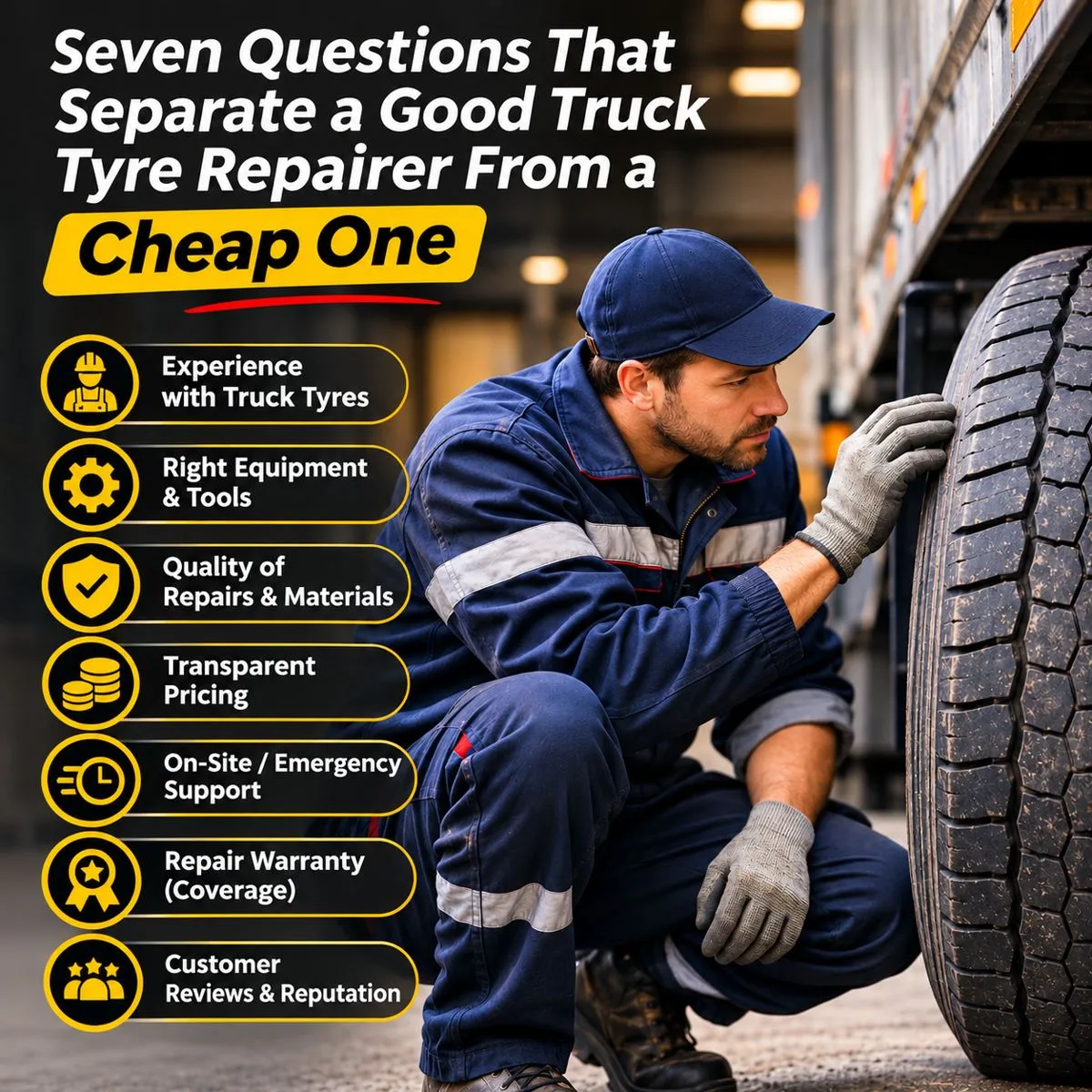
Every truck tyre provider will tell you they are fast, reliable and competitively priced. None of that is checkable before you commit, which is why most operators end up choosing on price and finding out about everything else afterwards.
The useful questions are more specific, and they can all be asked on a first phone call. Each one below has a right answer and a wrong one, and the wrong answers tend to arrive wrapped in reassurance. These are the seven that experienced fleet managers actually ask.
One: Will You Tell Me If the Tyre Is Repairable?
This is the question that reveals the most, because the honest answer costs the provider money.
A tread-area puncture within the repairable zone costs a small fraction of a replacement. A provider who assesses first and recommends a repair where one is possible is choosing the cheaper outcome for you over the larger invoice for them. One who quotes a replacement before looking at the casing has told you something important about how every future job will go.
The flip side matters just as much. Sidewall damage, exposed cords and any casing that has run flat cannot be repaired safely, and a provider willing to patch one of those to win the job is a liability rather than a bargain.
Two: What Is the Actual Arrival Window?
Ask for a time, not a reassurance. A provider who commits to a realistic window before leaving is running a dispatch system. One who says they will be there as soon as possible is telling you they do not know.
A realistic answer accounts for traffic and distance and is often longer than you would like. That honesty is worth more than an optimistic number, because the decision you make with it is different. If the answer is ninety minutes, you can plan around ninety minutes. If the answer is vague and turns into ninety minutes, you have lost the chance to arrange anything else.
Three: What Do You Carry on the Unit?
A well-stocked service unit carries the common steer, drive and trailer sizes, air, jacking gear, torque equipment and repair materials for tread-area damage. That covers the large majority of roadside and yard calls.
What matters is the honest answer about what it does not carry. Less common fitments, specific brands and matched sets across an axle group often need ordering, and a provider who says so upfront is letting you decide whether to wait or arrange something else. One who implies they carry everything will turn up without the tyre and charge for the visit anyway.
Ask what happens when the size is not on board. A provider with a workshop behind the mobile units can usually draw stock rather than ordering it, which is the practical difference between a job finished today and one finished Thursday. Operators dealing with a truck tyre repair Dandenong provider that runs both tend to notice the gap in second visits more than in prices.
Four: Who Torques the Wheel Nuts, and to What?
This question sounds pedantic and is the one most likely to produce a telling pause.
Wheel nuts on a heavy vehicle have a specified torque, and reaching it with a calibrated torque wrench is the difference between a wheel that stays on and one that does not. An impact gun alone does not do it, however confident the operator looks. A provider who answers this immediately and specifically is working to a standard. One who treats it as an odd question is not.
Ask about re-torque as well. Good practice after a wheel change is a re-torque check after a short period of running, and a provider who mentions it unprompted is a provider who has thought about what happens after they drive away.
Five: What Happens to the Old Casing?
Two reasons to ask, and both of them are about money.
First, disposal. A removed casing has to go somewhere legally, and a provider who takes it away as part of the job has handled an obligation that otherwise sits with you. Second, and more interesting, value. A casing removed at the right time still carries resale or retread value. One run to destruction carries none.
A provider who tells you a casing you were about to scrap is worth retreading is thinking about your costs rather than their invoice. That conversation almost never happens on an emergency call-out and almost always happens with a provider you have an ongoing arrangement with, which is an argument for having one.
Six: Can You Do Alignment and Balancing, and Where?
The right answer to this question includes the word workshop, and a provider who says they can align a heavy vehicle at your yard has disqualified themselves.
A heavy vehicle alignment needs the truck level on a measured surface with laser or computerised equipment, measuring every axle against a reference line rather than each in isolation. That equipment does not travel. Balancing is the same. These are the two jobs where a mobile-only provider genuinely cannot help, and the honest ones say so.
It matters more than it sounds, because alignment is what protects the tyres you just paid for. A provider running a truck tyre workshop Somerton style bay alongside mobile units can replace a set of steers and correct the geometry that destroyed the last set in the same visit. A mobile-only provider can only do the first half, and the second half is the half that stops it happening again.
Seven: What Will You Give Me in Writing?
A quote before work begins, an invoice that itemises the tyre, the labour, the call-out and any after-hours or distance charge separately, and a record of what was fitted where. None of that is unusual to ask for and all of it is unusual to be offered.
The itemised invoice matters because it is the only way to compare providers fairly. A single total tells you nothing about whether the tyre was dear and the labour cheap or the other way round, and it makes it impossible to spot a call-out charge that was never mentioned.
The record of what was fitted where matters later. It is the raw material for tracking cost per kilometre, and without it every future tyre purchase is a guess dressed up as experience.
The Pattern Across All Seven
Each question tests the same underlying thing, which is whether the provider is optimising for this job or for the relationship. Recommending a repair, quoting an honest arrival time, admitting what is not on the van, mentioning re-torque, flagging a retreadable casing, saying alignment needs a bay, itemising the invoice: every one of those answers costs them something today and earns them something over a year.
That is not a moral point, it is a commercial one. The provider who takes the smaller invoice today is the one still answering the phone at two in the morning in three years, because the relationship is worth more to them than the margin on a single casing.
Conclusion
Price is the easiest thing to compare and the least useful. Seven questions on a first phone call will tell you more than three quotes, and none of them take more than a minute to ask.
If you only ask two, make them the repairable question and the torque question. The first tells you whether they will cost you money unnecessarily. The second tells you whether they do the job to a standard. Everything else tends to follow from those two answers.
Frequently Asked Questions
How do I choose a truck tyre repairer?
Ask whether they assess repairability before quoting a replacement, what arrival window they will commit to, what stock the unit carries, how wheel nuts are torqued, what happens to the old casing, whether they have a workshop for alignment, and what they provide in writing.
Should a repairer always try to repair rather than replace?
Only when the damage qualifies. Tread-area damage within the repairable zone on a casing that has not been run flat can be repaired. Sidewall damage, exposed cords and run-flat casings cannot be repaired safely at any price.
Why does wheel nut torque matter so much?
Heavy vehicle wheel nuts have a specified torque, and reaching it needs a calibrated torque wrench rather than an impact gun alone. Good practice also includes a re-torque check after a short period of running.
Is a mobile-only provider a problem?
Not for most jobs. It becomes a problem for wheel alignment, balancing and multi-tyre work, which need a workshop. A provider with both can replace tyres and correct the geometry that wore them out in one visit.
What should a truck tyre invoice itemise?
The tyre, the labour, the call-out fee and any after-hours or distance charge, shown separately. A single total makes it impossible to compare providers or to spot a charge that was never mentioned.
Why ask what happens to the old tyre?
Partly legal disposal, which should be handled as part of the job. Partly value: a casing removed at the right time may still be worth retreading, while one run to destruction is worth nothing.
0 comments
Log in to leave a comment.
Be the first to comment.