
Perpetual DEX Development: How Modern DeFi Platforms Are Transforming Derivatives Trading

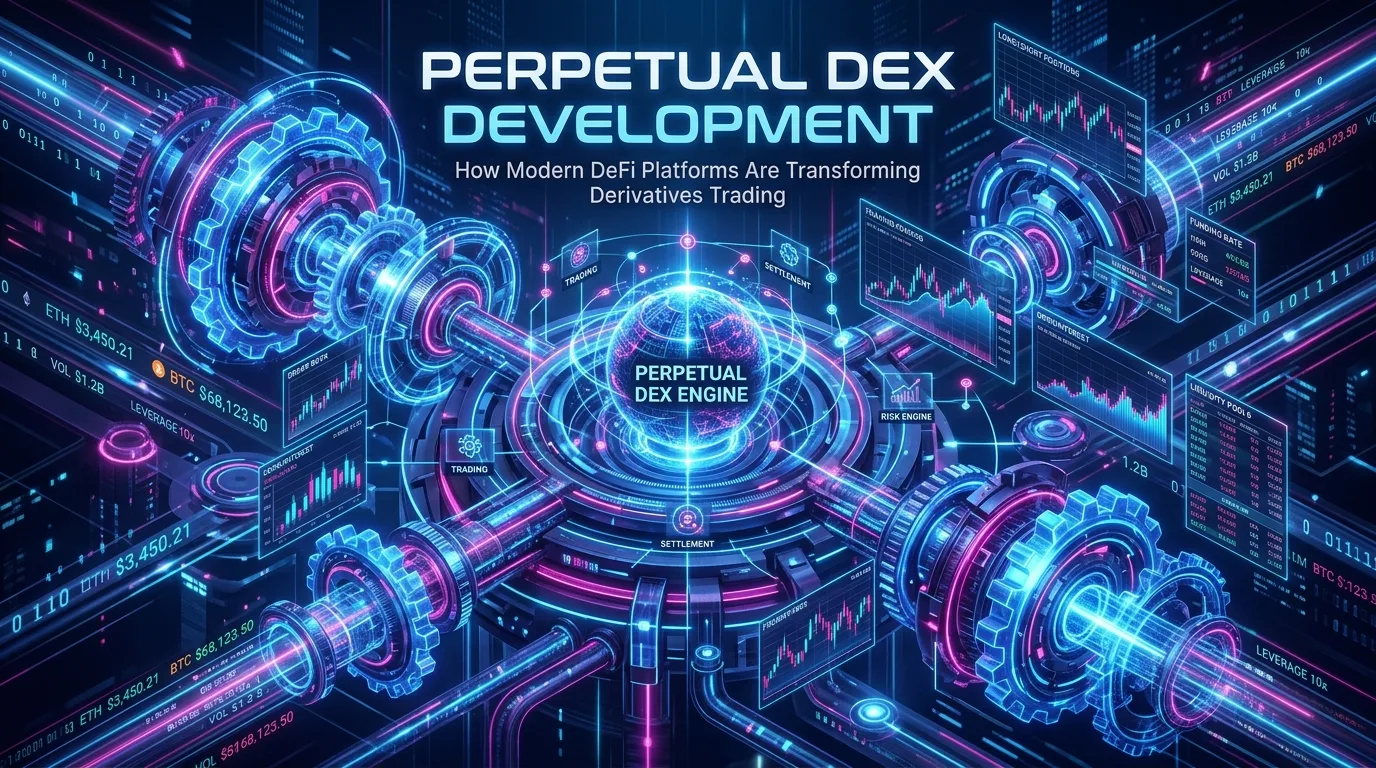
The decentralized finance (DeFi) ecosystem has evolved from simple token swaps and lending protocols into a sophisticated financial infrastructure capable of supporting advanced trading products. Among the most significant innovations is the rise of perpetual decentralized exchanges (Perpetual DEXs), which enable users to trade perpetual futures contracts without relying on centralized intermediaries. These platforms combine the transparency of blockchain technology with the functionality of traditional derivatives markets, offering traders access to leveraged positions while maintaining custody of their assets.
As institutional participation in digital assets grows and retail investors demand greater financial autonomy, perpetual DEXs have become a cornerstone of the next generation of decentralized trading. Their rapid adoption reflects a broader shift toward permissionless financial services that prioritize security, transparency, and global accessibility. Consequently, Perpetual DEX Exchange Development has emerged as one of the most important areas of blockchain innovation, enabling businesses and developers to build scalable, secure, and feature-rich trading ecosystems.
Understanding Perpetual DEXs and Their Growing Importance
A perpetual decentralized exchange is a blockchain-based platform that facilitates the trading of perpetual futures contracts. Unlike traditional futures, perpetual contracts do not have expiration dates, allowing traders to maintain positions indefinitely as long as they satisfy margin requirements.
Unlike centralized exchanges, users retain control of their assets through self-custodial wallets. Smart contracts automate core trading functions such as order execution, collateral management, liquidations, and settlement, reducing dependence on intermediaries while increasing transparency.
The popularity of perpetual DEXs has accelerated due to several market trends:
Increasing concerns about centralized exchange failures and custodial risks.
Rising demand for permissionless global trading.
Continuous improvements in blockchain scalability.
Expansion of Layer-2 networks that significantly reduce transaction costs.
Greater institutional interest in decentralized financial infrastructure.
Industry reports indicate that decentralized derivatives trading has expanded rapidly over the past few years, with billions of dollars in monthly trading volume flowing through leading perpetual DEX protocols. This growth demonstrates that decentralized derivatives are evolving from experimental products into an increasingly important segment of the broader digital asset economy.
Why Derivatives Matter in Modern Crypto Markets
Derivatives play a crucial role in mature financial systems because they provide tools for speculation, hedging, and risk management. The cryptocurrency market is no exception.
Professional traders frequently use perpetual futures to:
Hedge spot holdings during periods of uncertainty.
Trade with leverage to maximize capital efficiency.
Profit from both rising and falling markets.
Execute sophisticated quantitative trading strategies.
Manage portfolio risk across multiple digital assets.
Traditional crypto derivatives trading has largely been dominated by centralized exchanges. However, these platforms require users to surrender custody of their funds and trust the exchange to safeguard assets, maintain solvency, and process withdrawals fairly.
Recent industry events have highlighted the risks associated with centralized custodians, encouraging many traders to migrate toward decentralized alternatives that eliminate single points of failure.
Core Technologies Powering Perpetual DEX Development
Modern perpetual DEXs rely on several interconnected technologies that work together to create a seamless trading experience.
Smart Contracts
Smart contracts form the backbone of every decentralized derivatives exchange. They automatically execute trades, calculate funding payments, manage collateral, perform liquidations, and settle positions without manual intervention.
Since every transaction is recorded on the blockchain, market participants benefit from unprecedented transparency compared to traditional exchanges.
Automated Market Makers and Hybrid Models
Many perpetual DEXs originally relied on Automated Market Makers (AMMs), but newer platforms increasingly combine AMMs with sophisticated order books and external liquidity sources.
Hybrid architectures offer several advantages:
Better capital efficiency
Reduced slippage
Improved execution quality
Higher liquidity
Lower trading costs
This technological evolution has significantly narrowed the performance gap between decentralized and centralized exchanges.
Oracle Networks
Reliable pricing is essential for derivatives trading.
Decentralized oracle networks deliver real-time market prices from multiple data sources, helping ensure fair liquidations and accurate funding rate calculations while minimizing opportunities for price manipulation.
Layer-2 Scaling Solutions
One of the biggest historical challenges facing decentralized exchanges has been blockchain scalability.
Layer-2 technologies dramatically improve transaction throughput while reducing fees. Networks utilizing optimistic rollups, zero-knowledge rollups, and application-specific chains allow perpetual DEXs to process thousands of transactions at speeds approaching centralized trading platforms.
The result is a far smoother user experience with significantly lower operational costs.
Key Features Transforming the Trading Experience
Modern perpetual DEX platforms incorporate advanced functionality that rivals traditional financial exchanges while preserving decentralization.
Self-Custody
Users never relinquish ownership of their digital assets.
Funds remain inside personal wallets until smart contracts execute approved transactions, greatly reducing counterparty risk.
Leverage Trading
Most perpetual DEXs support leveraged positions ranging from modest multipliers to very high leverage, depending on platform design and risk management parameters.
While leverage amplifies potential returns, it also increases liquidation risk, making robust risk controls essential.
Transparent Liquidation Systems
Liquidation engines automatically protect protocol solvency by closing undercollateralized positions before losses spread throughout the system.
Unlike opaque centralized processes, liquidation rules remain visible within publicly auditable smart contracts.
Multi-Asset Support
Leading perpetual DEXs support trading across:
Bitcoin
Ethereum
Major altcoins
Stablecoins
Tokenized real-world assets in emerging ecosystems
The expansion of supported markets continues attracting increasingly diverse trading communities.
Risk Management Innovations
Sophisticated risk management distinguishes successful perpetual DEX platforms from earlier decentralized trading protocols.
Modern systems employ multiple safeguards including dynamic margin requirements, insurance funds, funding rate adjustments, circuit breakers, and automated liquidation engines.
Insurance funds absorb losses when liquidations fail to cover negative balances, protecting traders from cascading insolvencies.
Funding rates help maintain price alignment between perpetual contracts and underlying spot markets by encouraging equilibrium between long and short positions.
Some advanced protocols also implement real-time volatility monitoring, adaptive leverage limits, and portfolio-based margin systems that improve capital efficiency while reducing systemic risk.
These innovations have made decentralized derivatives considerably more resilient during periods of extreme market volatility.
Real-World Examples of Successful Perpetual DEX Platforms
Several decentralized exchanges have demonstrated that perpetual futures can achieve meaningful adoption while maintaining decentralization.
One platform pioneered an off-chain order book with on-chain settlement, delivering near-centralized performance while preserving user custody.
Another adopted a fully on-chain model emphasizing transparency and community governance.
A different protocol focused on synthetic liquidity pools that simplified market making while maintaining deep liquidity across multiple trading pairs.
Collectively, these projects process billions of dollars in trading volume, proving that decentralized derivatives can compete with established centralized exchanges in both performance and liquidity.
Their continued growth has inspired numerous startups to invest heavily in Perpetual DEX Exchange Development, recognizing the increasing demand for decentralized trading infrastructure.
Benefits for Traders and Businesses
Perpetual DEXs create value not only for individual traders but also for exchanges, financial institutions, and blockchain startups seeking to expand their product offerings.
For traders, the advantages include:
Full control over assets.
Transparent trading operations.
Global accessibility without geographic restrictions in many jurisdictions.
Continuous market availability.
Reduced counterparty exposure.
Businesses gain opportunities to build innovative financial ecosystems featuring decentralized derivatives, liquidity incentives, governance mechanisms, and integrated DeFi services.
Revenue can be generated through trading fees, premium analytics, liquidity services, staking programs, and institutional infrastructure offerings.
As blockchain adoption accelerates worldwide, organizations investing in Perpetual DEX Exchange Development position themselves to capitalize on one of the fastest-growing sectors within decentralized finance.
Conclusion
Perpetual decentralized exchanges are reshaping the future of crypto derivatives trading by combining transparency, self-custody, advanced trading capabilities, and decentralized infrastructure into a secure and efficient ecosystem. As blockchain technology continues to evolve, perpetual DEXs are expected to play an increasingly vital role in enabling accessible, scalable, and trustless financial markets for both retail and institutional participants. Businesses looking to capitalize on this growing sector should invest in robust, secure, and feature-rich solutions that can adapt to the rapidly changing DeFi landscape. Blockchain App Factory provides Perpetual DEX Exchange Development services, helping startups, enterprises, and crypto businesses build high-performance decentralized derivatives platforms with advanced trading features, strong security, seamless user experiences, and scalable blockchain architecture tailored to the evolving demands of the digital asset industry.
0 comments
Log in to leave a comment.
Be the first to comment.