
Instant Loan Safety in 2026: How to Verify a Digital Lender Before Sharing Your Data

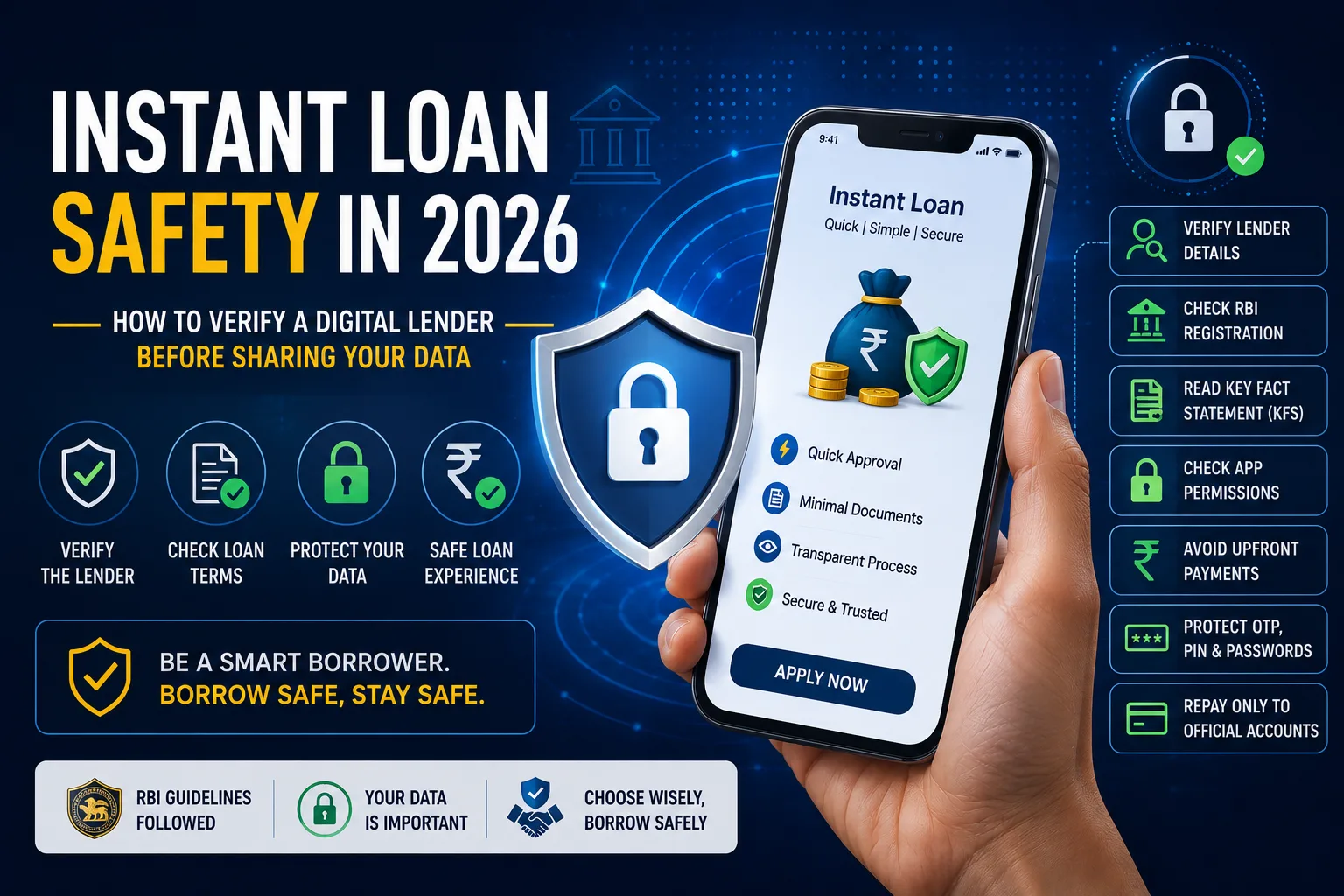
Getting an instant loan through a smartphone can be convenient when you need money for an emergency. But convenience should never replace caution. With hundreds of websites, mobile applications, and digital lending platforms offering quick credit, borrowers need to know how to identify safe instant loan apps before sharing personal, financial, or KYC information.
A legitimate digital lender should clearly identify the actual regulated lender, explain the loan's cost, provide appropriate disclosures, and follow applicable data and customer-protection requirements. The Reserve Bank of India (RBI) has established digital-lending requirements covering areas such as Key Fact Statements, borrower consent, data collection, loan disbursal, grievance redressal, and the involvement of Lending Service Providers.
This guide explains how to verify safe instant loan apps in India and what warning signs you should look for before submitting an application.
Why Is It Important to Verify an Instant Loan App?
An online loan application can require access to sensitive information such as your name, mobile number, PAN details, bank information, employment information, and identity documents.
Sharing these details with an unverified platform can expose you to privacy risks, fraud, misleading loan terms, or unauthorized use of personal information.
The RBI has previously warned consumers against sharing KYC documents with unidentified persons or unverified and unauthorized loan applications. It also advises people to verify the antecedents of companies offering loans online or through mobile applications.
Therefore, before using safe instant loan apps, borrowers should perform a few basic checks.
1. Identify the Actual Lender
One of the most important checks is finding out who is actually providing the loan.
A lending app may be operated by a technology company or Lending Service Provider (LSP), while the actual credit may be provided by a bank or NBFC.
Do not assume that the name of the app is automatically the name of the lender.
Look for information such as:
Name of the regulated lender
Registered office address
Customer-care details
Loan agreement
Privacy policy
Grievance redressal contact
Details of the LSP, if applicable
RBI's digital lending framework requires regulated entities to publish information about their digital lending arrangements, including their DLAs and LSPs, on their websites.
This makes verify loan app legitimacy an essential step before applying.
2. Check Whether the Lender Is Regulated
Before trusting an app, identify the bank or NBFC behind the loan and independently verify its regulatory status.
This is more reliable than trusting statements such as:
"100% approved"
"Guaranteed loan"
"No verification required"
"Loan without documents"
A genuine lender still has to follow applicable regulatory and lending requirements.
The RBI has specifically advised consumers to verify the company or firm offering loans online and cautioned against unauthorized digital lending platforms.
When researching safe instant loan apps, always start with the actual lender rather than relying only on an app's advertisements.
3. Read the Key Fact Statement Before Accepting the Loan
A Key Fact Statement (KFS) is one of the most useful documents for comparing a digital loan.
Under RBI's digital lending requirements, the KFS should contain important information including the Annual Percentage Rate (APR), repayment-related information, grievance redressal details, and the applicable cooling-off/look-up period. Charges that are not disclosed as required cannot simply be added later by the regulated entity.
Before accepting an offer, check:
Loan amount
APR
Interest and applicable charges
Processing fee
Tenure
EMI
Penal charges
Repayment schedule
Cooling-off/look-up period
Grievance redressal details
A loan should never be judged solely by the headline interest rate.
4. Be Careful About Upfront Payment Requests
One major warning sign is an unexpected demand to pay money before receiving a loan.
Fraudulent platforms may ask applicants to pay a supposed:
Verification fee
Security deposit
Insurance fee
File-opening charge
GST payment
Release fee
Do not automatically pay simply because someone claims that the payment is necessary to unlock your loan.
Instead, verify the charge against the official loan documentation and the lender's published information.
For digital lending safety, borrowers should be especially cautious when payment instructions are sent through personal WhatsApp numbers, unknown SMS links, or unrelated bank accounts.
5. Check the App's Data Permissions
Your financial information is valuable. A loan app should not be given unlimited access simply because it promises fast approval.
RBI's digital lending framework requires data collection to be need-based, with prior and explicit borrower consent and appropriate audit trails. It also requires digital lending apps and LSPs to maintain a clear privacy policy.
Before installing or using an app, review permissions relating to:
Contacts
Photos
Files
Location
Microphone
Camera
SMS
Device information
Ask yourself whether each permission is genuinely necessary for the service.
This is one of the most important loan app privacy checks you can perform.
6. Never Share OTPs, PINs, or Passwords
A legitimate digital lending process may require identity verification, but borrowers should never casually share banking passwords, UPI PINs, card PINs, or OTPs with another person.
An OTP can be used to authorize sensitive transactions or account activity.
If someone claiming to represent a lender asks you to disclose your UPI PIN or banking password, stop the process and independently contact the lender using its official contact details.
For safe instant loan apps, security should be treated as a two-way responsibility: the platform must protect your data, and you must protect your authentication credentials.
7. Check Where the Money Goes
RBI's digital lending guidelines contain important requirements around loan disbursal and repayment. In general, loan disbursal should go directly to the borrower's bank account, subject to specified exceptions, and loan servicing and repayment should be executed directly with the regulated entity rather than through an unrelated third-party pool account.
This is an important instant loan fraud prevention check.
Be suspicious if someone tells you to:
Receive money into another person's account
Repay an unrelated individual
Send money to a personal UPI ID
Transfer funds to unlock your loan
Make repayments through an unofficial channel
Always follow the payment instructions contained in the legitimate loan documentation.
8. Verify the Website and Contact Information
A professional-looking website does not automatically prove that an app is legitimate.
Check whether the platform provides:
Official domain
Company information
Registered lender details
Privacy policy
Terms and conditions
Customer-support information
Grievance redressal mechanism
Try contacting customer support before submitting sensitive information.
You can also search independently for the lender instead of clicking a promotional link received through SMS or social media.
This simple step can help with online loan verification.
9. Look for Transparent Loan Terms
A trustworthy loan provider should explain the cost of borrowing before you accept the loan.
Avoid platforms that advertise an extremely low rate but reveal substantial charges only after you begin the application.
Compare the complete cost rather than focusing on one number.
For example, evaluate:
Loan amount + interest + processing charges + applicable fees + repayment obligations = total borrowing cost
The KFS is particularly useful here because it gives borrowers standardized information about the cost and key terms of the loan.
10. Understand the Cooling-Off Period
Digital borrowers should also understand the cooling-off or look-up period mentioned in the KFS.
RBI's digital lending framework provides for a cooling-off period during which borrowers can exit a digital loan by paying the principal and the proportionate APR without penalty, subject to the applicable framework and disclosed terms.
This makes it important to read the loan agreement before accepting the funds.
Don't assume that accepting a loan and immediately changing your mind will always have the same consequences across every product.
Red Flags of an Unsafe Loan App
Before applying through any safe instant loan apps, watch for these warning signs:
A single warning sign does not always prove fraud, but multiple red flags should make you stop and verify the platform before proceeding.
What Should You Check Before Applying?
Use this quick loan app safety checklist:
Before Downloading
Search for the actual lender.
Check the company's official website.
Review the privacy policy.
Avoid unknown links sent through messages.
Before Submitting KYC
Confirm the lender's identity.
Understand why information is being requested.
Check app permissions.
Avoid sharing unnecessary documents.
Before Accepting the Loan
Read the KFS.
Check the APR.
Calculate the total repayment amount.
Review processing and other applicable charges.
Understand the EMI and tenure.
Check the cooling-off/look-up period.
Before Making Repayment
Confirm the official repayment account or mechanism.
Never share your UPI PIN or banking password.
Keep receipts and transaction records.
What to Do If You Suspect a Fake Loan App
If you discover that a loan app may be fraudulent, avoid sending additional money or documents.
Preserve relevant evidence such as:
Screenshots
Messages
Phone numbers
Payment receipts
Loan agreements
App details
Bank transaction records
You should then contact the relevant financial institution or authorities through official channels. RBI provides complaint and grievance mechanisms for covered regulated entities, and its consumer guidance also points users toward the Sachet portal for reporting certain unauthorized activities.
The Future of Safe Digital Lending
Digital lending is becoming increasingly automated, but speed should not come at the expense of consumer protection.
AI-based underwriting, digital KYC, automated verification, and real-time payment infrastructure can make legitimate lending faster. At the same time, borrowers need better awareness of privacy, lender identity, loan pricing, and digital fraud.
RBI's digital lending framework emphasizes borrower consent, data protection, transparent pricing, direct fund flows, grievance mechanisms, and accountability for regulated entities and their lending partners.
The safest approach is therefore simple:
Verify first. Read the terms. Protect your data. Then borrow.
Conclusion
Finding safe instant loan apps is not simply about choosing the application with the fastest approval or the largest advertised loan amount.
Before sharing your PAN, Aadhaar-related information, bank details, or other personal data, verify the actual lender, check its regulatory status, review the privacy policy, examine app permissions, read the KFS, and understand the total cost of borrowing.
A legitimate digital loan should provide transparency from application to repayment.
In 2026, the smartest digital borrower is not necessarily the person who gets a loan in the shortest time. It is the person who can identify a legitimate lender, understand the terms, protect their data, and borrow only what they can comfortably repay.
0 comments
Log in to leave a comment.
Be the first to comment.