
How Does an ERP System Track Project Based Labor Allocation From HR Software?
Understand how ERP Qatar integrates HR software with project costing to monitor the time worked, optimize labor utilization, and boost project profitability.

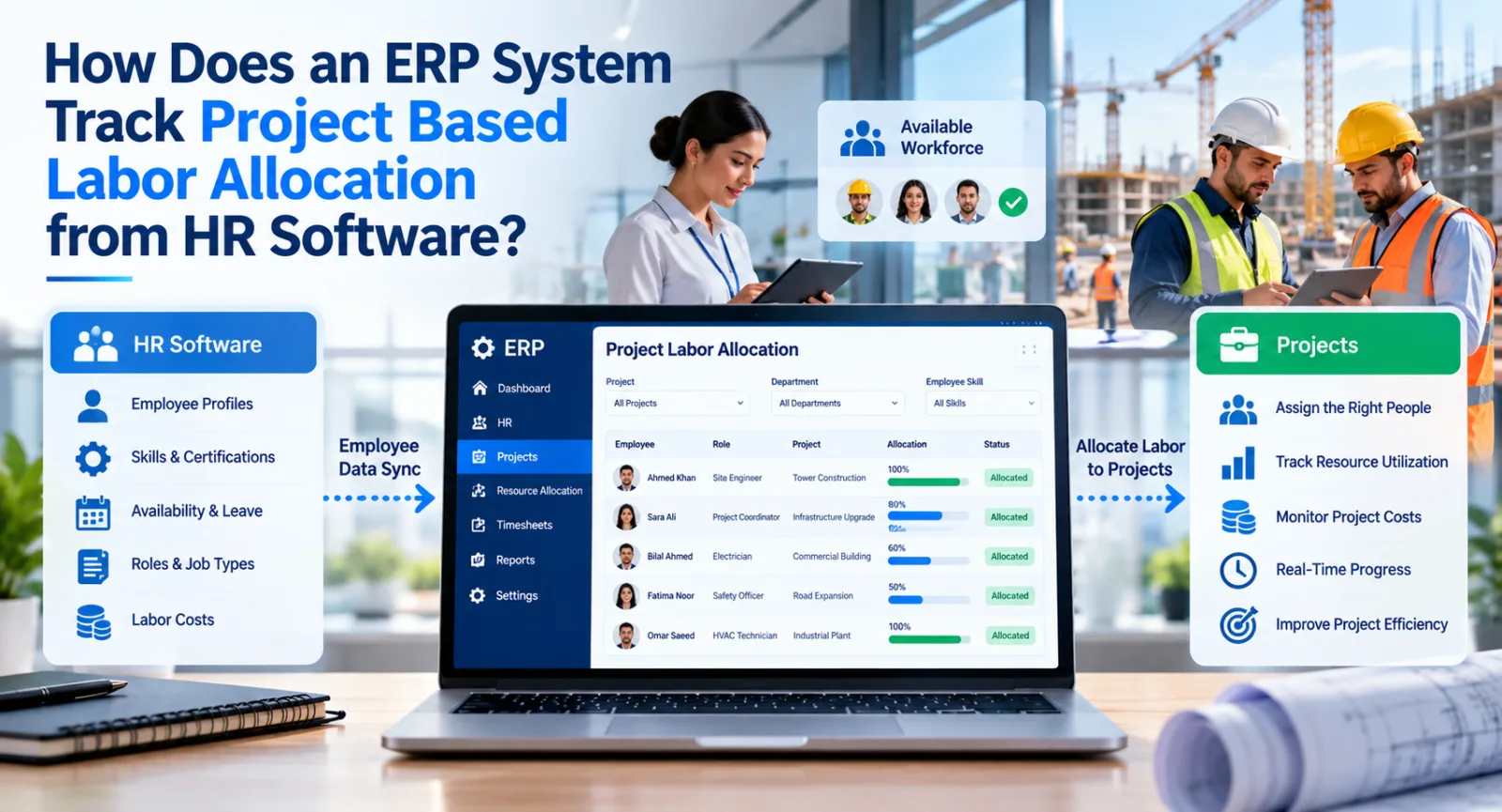
The success of a project can be determined by the accuracy of an organization's allocation of hours, labor costs and the capacity of employees to a specific project. In the absence of human resource records integration with project and financial management, project managers have difficulty determining cost overruns, nonproductive working hours, and shortages of resources.
An integrated ERP system will link employees' information to timesheets, project budgets, and financial information to provide labor cost visibility.
Relationship Between HR and Project Management and How It Can Be Connected.
The ERP employs this data to evaluate who can work on which project and the way their labor costs are registered. Employee records include job role, department, pay rate, employment status and cost centre assignment. These qualities are used by the ERP to decide who is able to work on what projects and the way their labour costs are to be logged.
This integration allows project managers to allocate resources, not based on excel files, but according to their skills, availability, and budgets.
The main information that is exchanged between the human resources and project module is the following:
- Employee IDs & job classification for accurate identification.
- Labor cost calculation: Standard and overtime rates.
- Identifiers for the project and the tasks used for cost attribution.
- Leave records and working hours, availability for capacity planning.
- Financial reporting department and cost centre information.
Depending on the modules and workflows set up in Sowaan ERP, the operational data can be integrated with workforce planning and project financial control.
How Are Employee Hours Assigned to Projects?
The accurate allocation of labor depends upon employees filling in time against projects and tasks. All these entries are recorded in the ERP system via timesheets, attendance integrations or approved time-tracking workflows.
Projects and Tasks Mapping
Every project has a different identifier, budget, timeline, and structure of tasks. When logging working hours, employees choose the appropriate project and task. This establishes a link between the activity done by the workers and the expenditure of the project.
Timesheet Validation
The system can optionally validate hours before they appear in project costing through a set of rules that can be configured. These checks can help detect duplicate entries, unauthorized submissions, missed entries, and overage entries.
Once they're approved, they're used to calculate labor costs, which removes the need for manual reconciliation between the HR, project management and finance teams.
The ERP Determines Project Labour Costs in the Following Way:
The allocation of labour is not complete until hours are recorded. Businesses also must turn those hours into positive monetary values. The ERP is configured with labor rates and applied to approved time entries and then the cost is allocated to the project, task, or cost center.
A Simple Computation Is:
Project labour cost = Approved hours × Applicable hourly labour rate
The cost of a loaded rate can vary based on the employer's accounting policy, and may consist of salary-related costs as well as employer costs. Overtime premiums, contractor rates and various employee rates can be managed by setting up separate rules.
The implementation of ERP Qatar will be successful if it is supported by the cost allocation, the use of currency, the approval process, and reporting where the company has project accounting needs.
Managers Monitor Labor Utilization in the Following Ways:
After labour entries are agreed and costs allocated, managers can track and monitor actual labour consumption against project estimates. Dashboards and project reports indicate the use of planned resources and the extent to which labor costs are being exceeded.
Some relevant performance metrics are:
- Budget variance: Difference between planned and actual labor cost.
- Labor utilization: Percentage of the available working hours used for productive and assigned activities.
- Cost per task - Labor costs that could be assigned to a discrete project task.
- Estimated cost at completion (ECC): Forecast of total labour expenditure based on the current performance.
- Unallocated hours: Hours logged when no project or cost centre has been approved.
These signs give business owners a sense of how to spot potential issues before they become a problem about delivery or profits. For instance, if labor costs are increasing but tasks are not being completed, there are potential estimates, scope, or resource allocation problems.
How HR Software Supports Workforce Planning
Project tracking is more effective when combining workforce with financial data. HR software offers data regarding leave approval, attendance, employee assignments, and work schedules, helping managers to see if resources have been planned.
This data can be leveraged by the ERP to identify areas of potential conflict, overloaded staff, and missed project coverage. Those managers then have the opportunity to re-allocate the appropriate employees or modify timelines before any shortages of resources affect the delivery.
Integration can also be helpful to differentiate between paid working hours and project billable hours. This can be especially helpful for consulting firms, engineering contractors, IT service providers and other companies working on several projects for each client.
But putting employees on file, setting up rates accurately and assigning proper timesheet approval duties is key to getting accurate results.
Controls That Help to Improve Accuracy of Labour Allocation
Automated costing is not enough to ensure reliable project costs. It is advisable for businesses to put in place preventive measures to ensure that there is no room for inaccuracy and a consistent audit trail.
Important controls include:
- Project permissions based on roles assigned to project assignments and timesheet approvals.
- Automated timesheet and budget overrun notifications.
- Regular payroll cost to project expense reconciliation.
- Rate changes and changes in the labor rates effective dates.
- Edit/approval/charge audit logs.
These controls help achieve accountability and enable finance teams to articulate the variances between the costs of payroll and the costs of labour per project.
How to Make Projects Profitable With Integrated ERP
Project-based labor allocation ties employee activity with operational performance and financial results. Businesses can now track resources more effectively, manage costs, and correlate HR and approved timesheets, project labor rates, and budgets.
In an ERP Qatar Implementation, the goal is to track the cost of labor, from time logs to project financial reports. A well-designed system enables business owners to detect cost overruns earlier, to optimize staff allocation, and to support business decision making concerning the profitability of a project.
0 comments
Log in to leave a comment.
Be the first to comment.