
Full Stack AI Development for Smart Factory Transformation
Transform manufacturing with integrated AI, scalable technology, and smarter factory operations.

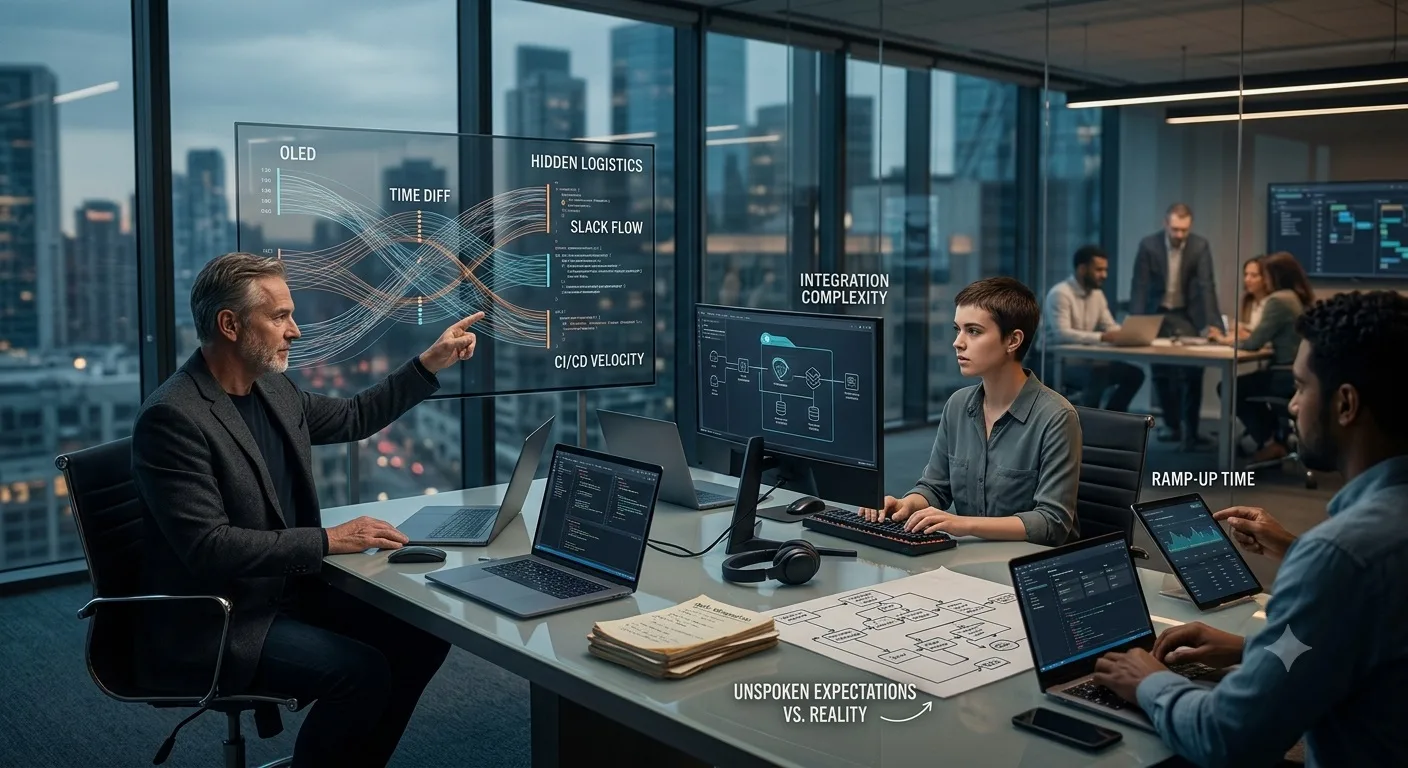
I once watched a plant manager stare at a "smart factory" dashboard showing every line green, while two floor supervisors were on handheld radios trying to figure out why a conveyor had jammed on line 4. The sensors were real. The dashboard was real. The gap between what the software showed and what was actually happening on the floor was real too — and it is the gap that decides whether a smart factory initiative earns its budget or quietly gets shelved.
That gap is rarely a sensor problem. It is almost always a full stack problem — the front end, the backend, the AI models, and the plant integrations were never built by one team that could see the whole picture.
What Actually Makes a Factory "Smart" Beyond the Sensors?
Deploying IIoT sensors is the easy 20% of smart factory transformation. The hard 80% is turning that raw telemetry into something an operator, a planner, and a plant manager can each act on — in real time, without three different logins. A digital twin that just mirrors machine state back to a screen is not smart; it is expensive instrumentation. It becomes smart only when the application layer connects that live data to the production schedule, the maintenance calendar, and the quality system it needs to influence.
That connective layer is exactly where most smart factory programs stall. The sensors ship on time. The application layer that turns sensor data into a decision an operator can trust does not — usually because no single team was accountable for building it end to end.
📖 Good Read: MEAN vs MERN — Find Out Which Framework Is Ideal For You
Who Should Own the Smart Factory Application Layer, End to End?
A full stack AI team takes ownership of the front end, the backend logic, the API layer, the database design, the cloud infrastructure, and the AI/ML pipeline together — not as four separate contracts with four separate change-request queues.
In a smart factory context, that ownership looks like:
- One team tracing the full data path. When a digital twin shows a reading that does not match the floor, the same engineers can follow it from the PLC through the API into the backend and back — instead of opening tickets with the sensor vendor, the integrator, and the dashboard provider separately.
- AI decisions embedded in the operator's existing screen. A quality-flag or a predictive-maintenance alert lands inside the interface the operator already has open, not in a separate analytics tool that gets checked once a week.
- Plant integrations designed alongside the AI, not after it. Connecting the twin to an MES, an ERP, and a PLC fleet is an architecture decision, and it works far better when the people building the AI model are in the same sprint as the people building that connection.
This is the practical reason more manufacturers now choose to hire dedicated full stack developers for smart factory work, rather than stitching together separate vendors for the sensors, the software, and the AI.
📖 Good Read: Enterprise Full Stack Development: Best Practices
How Do Digital Twins and Agentic AI Change the Smart Factory Conversation in 2026?
For a few years, a digital twin's job was mostly to display state: temperature, vibration, throughput. In 2026, the more useful version of a twin does not just show a reading — it reasons about it. Industry analysts covering smart factory technology this year have made a similar distinction: a co-pilot gives an operator answers, while an agent works toward an outcome on its own, checking the schedule, narrowing down a likely cause, and drafting the corrective action for a human to approve.
That is a meaningfully different design problem than a dashboard. It means the twin, the AI model reasoning over it, and the guardrails on what the system is allowed to adjust all need to be built by people who understand the full path from sensor to action — not handed off in pieces. Split that build across vendors and you end up with an agent nobody on the floor is willing to trust.
Which Stack Keeps a Smart Factory Platform Running at Production Scale?
Smart factory data — telemetry, production events, maintenance logs, quality readings — is high-volume and constantly changing shape as new sensor types get added, which is exactly what MERN and MEAN were built to absorb.
MERN (MongoDB, Express.js, React, Node.js) suits an early smart factory rollout well: MongoDB's document model takes a new sensor type without a schema migration, and React can update a single dashboard tile over a WebSocket without reloading the whole screen. That speed matters when you are proving a digital twin on one or two lines before asking for budget to scale it.
MEAN (MongoDB, Express.js, Angular, Node.js) earns its place once the twin becomes a multi-plant platform. Angular's stricter architecture keeps UI patterns consistent when dozens of developers across time zones are maintaining the same portal for a global manufacturing footprint over several years.
Both deploy cleanly on AWS, Azure, or Google Cloud with containerized microservices, so a production peak does not force a re-architecture. Start with MERN to prove the twin works; move toward MEAN once it needs to run the same way across every plant.
📖 Good Read: How to Build High-Performing Remote Engineering Teams Across Time Zones
How Do We Know the Smart Factory Investment Is Actually Working?
Set the baseline before the digital twin goes live, not after — otherwise "is this working" turns into an argument about which dashboard to believe.
The numbers that hold up best in front of a board:
- Unplanned downtime — the change in reactive maintenance events once the twin's alerts sit inside the operator's actual screen.
- Mean time to detect and correct — the gap between an anomaly appearing and a logged corrective action, before and after the twin goes live.
- First-pass quality yield — the drop in defect escape rate once AI-driven inspection is wired into the line, not run as a side report.
- Schedule adherence — how often production actually hits the plan once the twin's forecasts feed planning directly, instead of being read manually.
Manufacturers that fix these baselines at kickoff are the ones who can walk into a board review with a real before-and-after number, not a demo.
If you are trying to work out whether your next smart factory phase needs another point solution or one accountable team building the whole path from sensor to decision, I am happy to talk through what that looks like for your lines specifically.
Full Stack AI Development for Smart Factories. One team, owning the front end, backend, AI models, and plant integrations together — so the digital twin on the dashboard matches what is actually happening on the floor. Talk to our engineering team.
Hidden Brains is a CMMI Level-3 certified manufacturing software development company in USA, with delivery teams serving manufacturers across the US, UK, UAE, and Southeast Asia.
Related Articles
- How AI Engineers Are Changing the Way Businesses Build Software
- From Legacy Systems to AI-Ready Enterprises
- From Data to Decisions: Building AI-Ready Products with a Strong Data Foundation
- Digital Healthcare Is Reshaping Patient Care Beyond Hospitals
- Why US Companies Are Choosing to Hire Dedicated Remote Developers
0 comments
Log in to leave a comment.
Be the first to comment.