
Enterprise Application Market Analysis: Size, Global Opportunities and Future Outlook 2026-2034

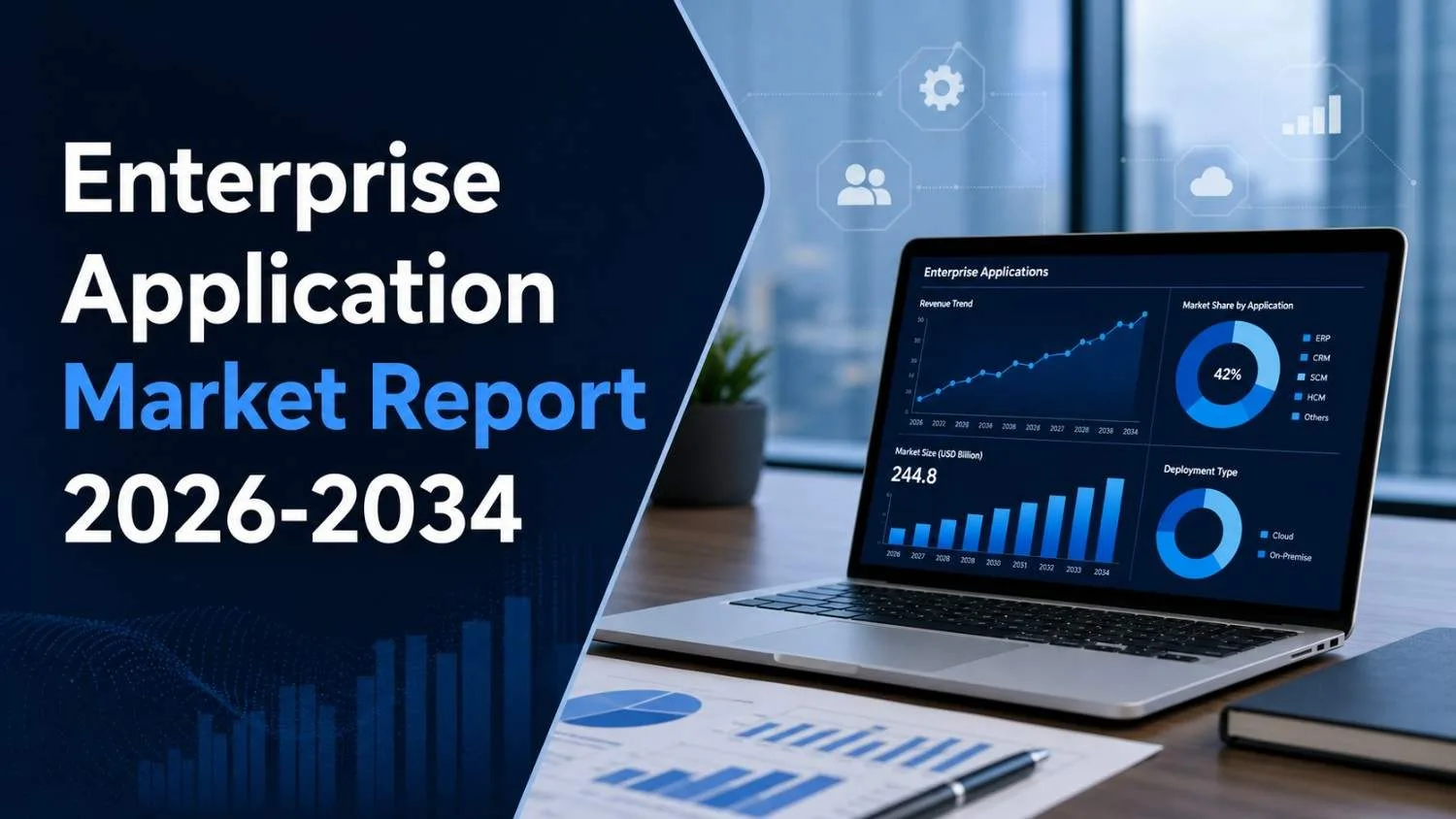
The global enterprise application market size reached USD 335.4 Billion in 2025, according to IMARC Group. The market is projected to reach USD 587.8 Billion by 2034, exhibiting a growth rate (CAGR) of 6.24% during 2026-2034. Growth is anchored in accelerating global digitization, enterprise geographic expansion, and sustained IT sector investment. The report segments the market by solution, organization size, deployment mode, end user, and region, covering Asia Pacific, Europe, North America, Latin America, and the Middle East and Africa.
Key Data Points: Enterprise Application Market at a Glance
- Market Size (2025): USD 335.4 Billion
- Market Forecast (2034): USD 587.8 Billion
- CAGR (2026–2034): 6.24%
- Base Year: 2025
- Forecast Period: 2026–2034
- Absolute Value Added (2025–2034): USD 252.4 Billion
- Solutions Covered: Customer Relationship Management, Enterprise Resource Planning, Supply Chain Management, Analytics and Business Intelligence, Human Capital Management, Productivity Tools, and Others
- Organization Size: Small and Medium Enterprises, Large Enterprises
- Deployment Modes: On-premises and cloud-based
- End Users: BFSI, manufacturing and retail, healthcare and pharmaceuticals, IT and telecommunication, government and others
- Regions Covered: Asia Pacific, Europe, North America, Latin America, Middle East and Africa
- Primary Driver: Expansion of businesses and enterprise digitization
What Defines the Enterprise Application Market?
Enterprise applications are large-scale software systems deployed to operate core business functions across distributed organizational structures. The category spans customer relationship management (CRM), enterprise resource planning (ERP), and supply chain management (SCM) platforms, alongside analytics and business intelligence, human capital management, and productivity tooling.
These systems consolidate fragmented workflows into unified data architectures. Integration boosts productivity and reduces costs while fostering innovation, enabling businesses to respond swiftly to market changes and customer demands.
Grab a sample copy of this report: https://www.imarcgroup.com/enterprise-application-market/requestsample
What Factors Are Driving Enterprise Application Market Growth?
Three structural forces underpin the 6.24% CAGR.
- Business expansion. IMARC Group identifies the expansion of businesses as a primary impelling force behind the market's trajectory. As organizations enter new geographies, manual coordination fails and standardized application layers become operationally mandatory rather than discretionary.
- Digitization of enterprise operations. Rapid digital transformation across industries has pushed vendors to deploy enterprise-grade solutions at scale. Connected device proliferation across corporate estates generates data volumes that legacy systems cannot process, forcing modernization cycles.
- Consulting-led implementation. The maturation of enterprise consulting services has reduced deployment friction for mid-market buyers, widening the addressable base beyond large multinationals.
Continuous software innovation and sustained research and development activity by major vendors reinforce the forecast through 2034.
How Is the Enterprise Application Market Segmented?
- By solution: The market is segregated into customer relationship management, enterprise resource planning, supply chain management, analytics and business intelligence, human capital management, productivity tools and others.
- By organization size: Small and medium enterprises and large enterprises. Large enterprises supply baseline licensing volume; SMEs represent the elasticity layer unlocked by subscription pricing.
- By deployment mode: On-premises and cloud-based. This split captures the central architectural migration reshaping vendor revenue models.
- By end user: BFSI, manufacturing and retail, healthcare and pharmaceuticals, IT and telecommunication, government and others.
Which Companies Lead the Enterprise Application Market?
The competitive landscape combines platform vendors with global systems integrators:
- Accenture plc
- Fujitsu Limited
- Infosys Limited
- International Business Machines Corporation
- iTransition Group
- Microsoft Corporation
- Oracle Corporation
- Pegasystems Inc.
- Salesforce.com Inc.
- SAP SE
- Software AG
- Tata Consultancy Services Limited
This dual structure matters commercially. Licence revenue concentrates among platform owners, while implementation and managed-services revenue accrues to integrators — meaning a single enterprise deployment generates multiple monetisation events across the value chain.
Analytical Insight: Market Dynamics and Outlook
A 6.24% CAGR positions enterprise applications as infrastructure-grade rather than speculative growth. The figure is materially below adjacent categories — IMARC projects the cloud enterprise application software market at a 10.59% CAGR during 2026-2034, which signals that incremental expansion is migrating toward cloud-delivered architectures within the broader category.
- Regional structure. Coverage spans Asia Pacific, Europe, North America, Latin America, and the Middle East and Africa, with forecasts delivered at global, regional, and country level. North America and Europe anchor replacement-cycle demand on mature installed bases; Asia Pacific and the Middle East and Africa contribute greenfield deployment volume.
- Vertical concentration. Regulated sectors — BFSI, healthcare and pharmaceuticals, and government — require compliance-grade architectures, data residency controls, and audit trails. These constraints sustain premium pricing and lengthen switching cycles, favouring incumbents. Manufacturing and retail convert operational complexity directly into SCM and ERP demand.
- Principal constraint. Integration complexity across heterogeneous legacy estates remains the dominant adoption barrier. Migration cost, data-model reconciliation, and organizational change management routinely exceed licence expenditure. Vendors that compress time-to-value and evidence measurable return on investment are best positioned to capture the USD 252.4 Billion in absolute value added between 2025 and 2034.
Note: If you require specific details, data, or insights that are not currently included in the scope of this report, we are happy to accommodate your request. As part of our customization service, we will gather and provide the additional information you need, tailored to your specific requirements. Please let us know your exact needs, and we will ensure the report is updated accordingly to meet your expectations.
About Us:
IMARC Group is a global management consulting firm that helps the world's most ambitious changemakers to create a lasting impact. The company provides a comprehensive suite of market entry and expansion services. IMARC offerings include thorough market assessment, feasibility studies, company incorporation assistance, factory setup support, regulatory approvals and licensing navigation, branding, marketing and sales strategies, competitive landscape and benchmarking analyses, pricing and cost research, and procurement research.
Contact Us:
IMARC Group
134 N 4th St. Brooklyn, NY 11249, USA
Email: [email protected]
Tel No: (D) +91 120 433 0800
United States: +1-201-971-6302
0 comments
Log in to leave a comment.
Be the first to comment.