
DevOps Course in Telugu: Industry Trends and Future Opportunities
Enrolling in a DevOps Course in Telugu is an excellent way to understand the latest DevOps practices while learning complex technical concepts in your native language.

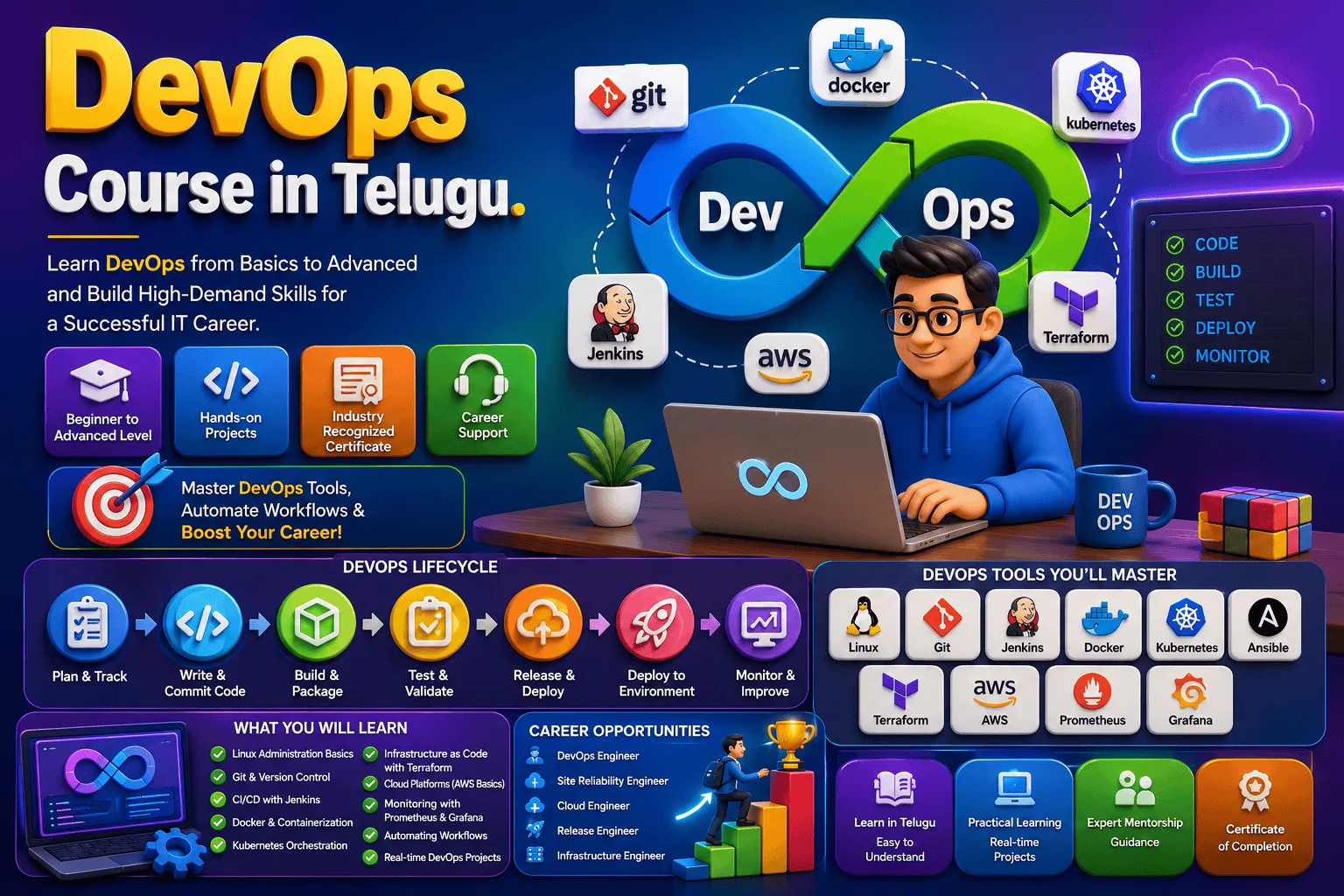
Introduction
The technology industry is evolving at an unprecedented pace, and DevOps has become one of the most important methodologies for modern software development and IT operations. Organizations across the globe are investing in cloud computing, automation, Artificial Intelligence (AI), and continuous delivery to improve software quality and accelerate digital transformation. As a result, the demand for skilled DevOps professionals continues to grow across industries.
Enrolling in a DevOps Course in Telugu is an excellent way to understand the latest DevOps practices while learning complex technical concepts in your native language. With hands-on training, real-time projects, and exposure to industry-standard tools, learners can prepare themselves for future-ready careers in cloud computing and automation. This article explores the latest DevOps industry trends and the exciting career opportunities that await aspiring professionals.
Why DevOps Is Shaping the Future of IT
Modern businesses require faster software development, reliable infrastructure, and continuous innovation. Traditional development methods often struggle to meet these demands due to manual processes and communication gaps between development and operations teams.
DevOps addresses these challenges by promoting collaboration, automation, and continuous improvement. Organizations implementing DevOps experience:
Faster software releases
Improved application quality
Reduced deployment failures
Better collaboration across teams
Increased operational efficiency
Enhanced customer satisfaction
These advantages have made DevOps one of the most valuable skill sets in today's technology landscape.
Current Industry Trends in DevOps
The DevOps ecosystem is continuously evolving with new technologies and best practices. A DevOps Course in Telugu introduces learners to these trends, helping them stay competitive in the IT industry.
1. Cloud-Native Development
Organizations are increasingly building applications specifically for cloud platforms instead of traditional on-premises infrastructure.
Cloud-native applications offer:
Better scalability
Improved performance
Faster deployments
Greater flexibility
Cloud platforms such as AWS and Microsoft Azure continue to dominate enterprise IT environments.
2. Containerization With Docker
Containers have become the preferred method for packaging and deploying applications.
Docker enables developers to:
Create lightweight applications
Ensure environment consistency
Simplify deployments
Improve application portability
Containerization remains one of the most important skills for modern DevOps Engineers.
3. Kubernetes Adoption
As organizations deploy hundreds of containers, Kubernetes has become the industry standard for container orchestration.
Kubernetes provides:
Automated deployment
Auto scaling
Load balancing
Self-healing applications
High availability
Large enterprises continue expanding their Kubernetes-based infrastructure.
4. Infrastructure as Code (IaC)
Infrastructure management is shifting from manual configuration to automated provisioning.
Popular IaC tools include:
Terraform
Ansible
Infrastructure as Code enables organizations to:
Automate infrastructure creation
Improve consistency
Reduce configuration errors
Accelerate cloud deployments
5. DevSecOps
Security is becoming an integral part of the DevOps lifecycle.
DevSecOps integrates security practices into software development and deployment by:
Automating security testing
Scanning application vulnerabilities
Improving compliance
Reducing security risks
Organizations increasingly seek DevOps professionals with security knowledge.
6. AI and Machine Learning in DevOps
Artificial Intelligence (AI) and Machine Learning (ML) are transforming DevOps by enabling predictive monitoring and intelligent automation.
AI-powered DevOps helps organizations:
Detect system failures early
Predict infrastructure issues
Optimize resource utilization
Improve application performance
Automate troubleshooting
AI-driven automation is expected to become a major part of future DevOps environments.
7. GitOps
GitOps is an emerging operational framework where Git repositories act as the single source of truth for infrastructure and application configurations.
Benefits include:
Improved version control
Easier rollbacks
Automated deployments
Better collaboration
Enhanced infrastructure consistency
GitOps is rapidly gaining popularity among cloud-native organizations.
Essential Skills for Future DevOps Engineers
To remain competitive, aspiring professionals should develop expertise in the following technologies:
Linux Administration
Git and GitHub
Shell Scripting
Jenkins
Docker
Kubernetes
Terraform
Ansible
AWS
Microsoft Azure
CI/CD Pipelines
Prometheus
Grafana
Infrastructure as Code
A DevOps Course in Telugu provides structured training on all these essential technologies through practical exercises and real-world projects.
Hands-On Learning With Real-Time Projects
Practical experience is essential for building a successful DevOps career.
Typical projects include:
Creating automated CI/CD pipelines
Deploying applications on AWS
Managing Docker containers
Orchestrating Kubernetes clusters
Automating infrastructure using Terraform
Configuring servers with Ansible
Monitoring applications with Prometheus and Grafana
Working on real-time projects helps learners gain confidence and prepare for enterprise-level DevOps responsibilities.
Future Career Opportunities
As DevOps adoption continues to expand, professionals can explore a wide range of career opportunities.
Popular job roles include:
DevOps Engineer
Cloud Engineer
AWS DevOps Engineer
Azure DevOps Engineer
Platform Engineer
Automation Engineer
Infrastructure Engineer
Site Reliability Engineer (SRE)
Cloud Operations Engineer
DevSecOps Engineer
These positions are available in software companies, financial institutions, healthcare organizations, e-commerce businesses, cloud providers, and multinational corporations.
Benefits of Learning DevOps Today
Investing in a DevOps Course in Telugu offers several long-term career advantages.
Key benefits include:
High industry demand
Competitive salary packages
Global career opportunities
Continuous learning
Exposure to cutting-edge technologies
Better job security
Faster career growth
Opportunities to work on innovative projects
DevOps professionals remain among the most sought-after experts in the IT industry.
Tips to Stay Ahead in the DevOps Industry
To build a successful future in DevOps:
Continuously practice Linux and scripting.
Gain hands-on experience with AWS and Azure.
Learn Docker and Kubernetes thoroughly.
Build end-to-end DevOps projects.
Maintain an active GitHub portfolio.
Earn industry-recognized certifications.
Stay updated with emerging technologies like GitOps and DevSecOps.
Participate in technical communities and open-source projects.
Practice technical interview questions regularly.
Lifelong learning is essential for staying competitive in this rapidly evolving field.
Why Learn DevOps in Telugu?
Learning in your native language helps simplify complex concepts and improves overall understanding.
A DevOps Course in Telugu offers:
Easy-to-understand explanations
Practical demonstrations
Real-time project guidance
Better concept clarity
Increased confidence
Faster learning
Strong technical foundation
This learning approach is especially beneficial for beginners and students entering the IT industry.
Conclusion
A DevOps Course in Telugu: Industry Trends and Future Opportunities provides learners with the knowledge and practical skills required to succeed in one of the fastest-growing areas of technology. As organizations increasingly adopt cloud computing, automation, AI-driven operations, DevSecOps, and GitOps, the demand for skilled DevOps professionals will continue to rise.
By mastering industry-standard technologies such as Linux, Git, Jenkins, Docker, Kubernetes, AWS, Azure, Terraform, Ansible, Prometheus, and Grafana, learners become well-prepared for modern IT environments. Combined with real-time projects, practical training, and continuous upskilling, a DevOps Course in Telugu equips students, freshers, and working professionals with the expertise needed to build a successful, future-proof career in cloud computing, automation, and software delivery. Investing in DevOps education today is a smart step toward long-term professional growth and success in the ever-evolving technology industry.
0 comments
Log in to leave a comment.
Be the first to comment.