
Azure Data Engineer Course in Telugu – Beginner to Job-Ready Data Engineer Roadmap
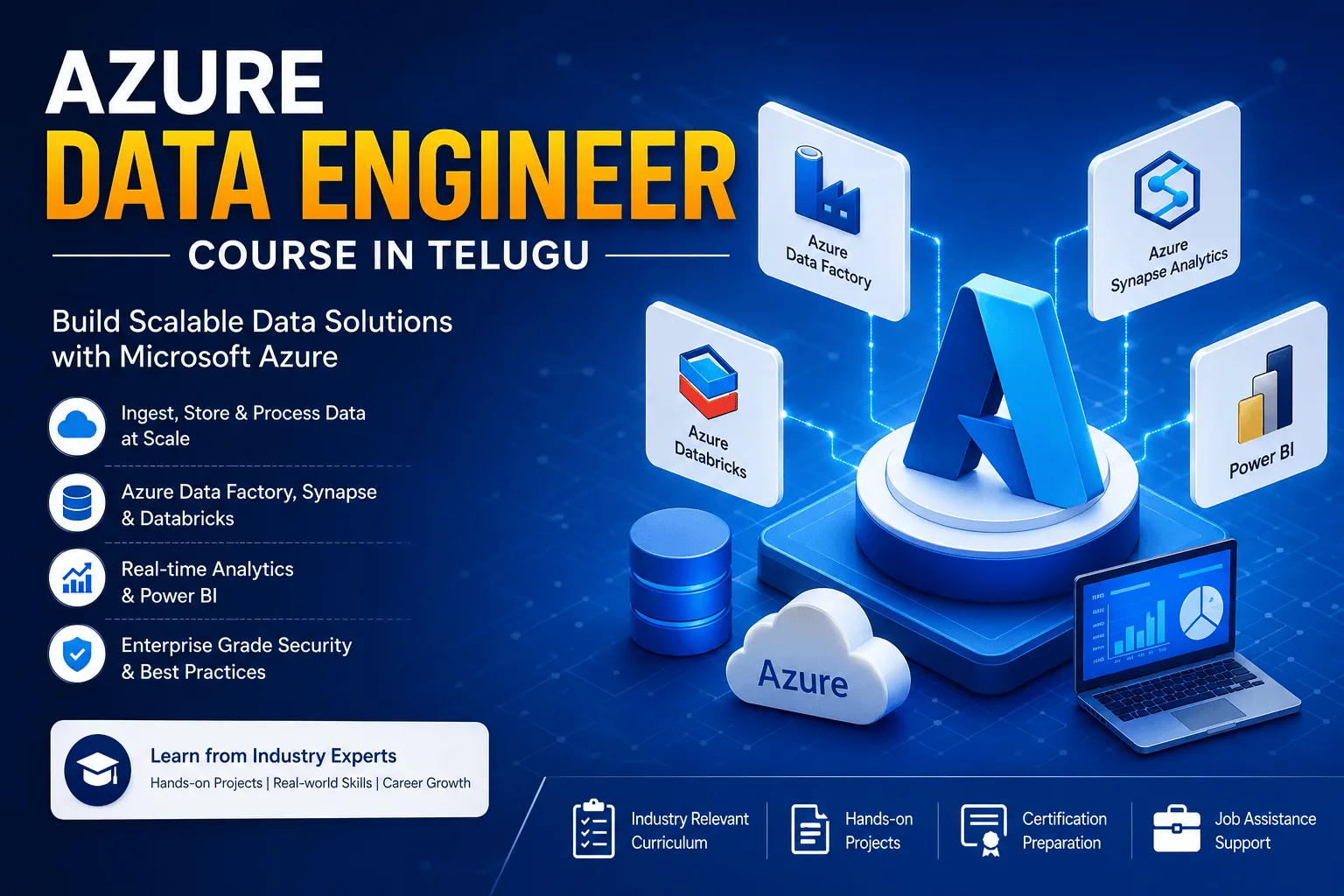
Azure Data Engineer Course in Telugu can provide a structured learning path from basic concepts to practical skills.

Introduction
The demand for skilled Data Engineers is growing as organizations increasingly depend on data for decision-making. Companies collect information from websites, mobile applications, customer interactions, transactions, and business operations. However, this data must be collected, processed, stored, and prepared before it can be used effectively.
This is where Data Engineers play an important role. They build systems and pipelines that help organizations manage large volumes of data. For beginners who want to enter this field, an Azure Data Engineer Course in Telugu can provide a structured learning path from basic concepts to practical skills.
Becoming job-ready does not happen by learning one tool alone. It requires a combination of technical knowledge, hands-on practice, projects, and problem-solving abilities.
Step 1: Understand the Basics of Data Engineering
Before learning Azure tools, beginners should understand what Data Engineering actually involves.
A Data Engineer works with data from different sources and builds systems that make the data available for analytics and business use. The main responsibilities may include data collection, transformation, storage, pipeline development, and performance monitoring.
Understanding concepts such as structured data, unstructured data, databases, data warehouses, and data lakes creates a strong foundation.
Step 2: Learn SQL and Database Fundamentals
SQL is one of the most important skills for aspiring Data Engineers.
Most organizations store structured data in databases, and SQL helps professionals retrieve and manipulate that information.
Beginners should learn:
SELECT statements
WHERE conditions
JOIN operations
GROUP BY
Aggregate functions
Subqueries
Views
Database relationships
Strong SQL skills can help learners understand how data is organized and processed in real-world systems.
Step 3: Learn Programming Basics
Programming is another useful skill for Data Engineers. Python is widely used for data processing, automation, and scripting.
Learners do not need to become advanced programmers immediately. They can start with basic concepts such as variables, loops, functions, conditions, lists, and dictionaries.
An Azure Data Engineer Course in Telugu can help beginners understand how programming concepts are applied in data-related tasks.
Step 4: Understand Cloud Computing
Cloud computing has become an important part of modern IT infrastructure. Instead of managing everything on physical servers, organizations use cloud platforms to access computing power, storage, and other services.
Before exploring Azure, learners should understand:
What cloud computing is
Public and private cloud
Cloud storage
Scalability
Availability
Cloud security
These concepts make it easier to understand how Azure services work.
Step 5: Start Learning Microsoft Azure
Once learners understand the fundamentals, they can begin exploring Microsoft Azure.
Azure provides several services for Data Engineering, including:
Azure Data Factory
Azure Data Lake Storage
Azure SQL Database
Azure Databricks
Azure Synapse Analytics
Each service plays a different role in the data ecosystem.
For example, Azure Data Factory helps build data pipelines, while Azure Data Lake Storage can store large volumes of data.
Step 6: Learn Data Pipelines and ETL
Data pipelines are an important part of Data Engineering.
A pipeline moves data from one system to another and may include multiple stages such as extraction, transformation, and loading.
Learners should understand ETL processes and practice building pipelines using Azure Data Factory.
Hands-on exercises can include importing data from files, transforming information, and loading it into a cloud storage system.
Step 7: Learn Big Data Technologies
As data volumes grow, traditional processing systems may not be enough. Big Data technologies help process large datasets efficiently.
Apache Spark is an important technology used for distributed data processing.
Azure Databricks provides an environment where learners can work with Spark and perform large-scale transformations.
Understanding basic Spark concepts can help learners expand their Data Engineering skills.
Step 8: Build Real-World Projects
Projects are essential for becoming job-ready.
Learners can build projects such as:
Sales data pipelines
Customer data processing systems
E-commerce analytics pipelines
Automated ETL workflows
Cloud-based data warehouse solutions
Projects demonstrate practical knowledge and help learners understand real-world challenges.
Conclusion
Becoming a job-ready Data Engineer requires patience and consistent practice. Learning SQL, programming, cloud computing, Azure services, data pipelines, and Big Data technologies can help beginners develop a strong skill set.
An Azure Data Engineer Course in Telugu can provide a structured roadmap for learners who want to start from the basics and gradually move toward practical Data Engineering skills. With projects and continuous learning, beginners can prepare themselves for opportunities in the growing cloud data industry.
0 comments
Log in to leave a comment.
Be the first to comment.